
BETTER THAN THIS — Article 4 of 9
This is the fourth article in the Better Than This series. If you’re new, you may want to start with Article 1: The Workplace That Wears You Down, or pick up from Article 3: Burnout Is Not a Personal Failing
In the last article, we talked about what burnout actually is — and introduced the idea that it may be less about accumulated fatigue and more about what happens when a nervous system has been running on high alert for a very long time with nowhere to go.
That idea is worth staying with. Because it changes how we think about solutions.
If burnout were simply a matter of overdoing it, rest would fix it. If toxic workplace stress were simply a matter of thinking about it differently, a mindset shift would resolve it. If the problem were primarily cognitive, we could think our way out.
But the nervous system isn’t primarily cognitive. And a lot of what happens to people in chronic stress — the overreactions, the shutdowns, the moments of going blank, the inability to access the version of yourself you know is in there somewhere — isn’t a character issue. It’s a physiological one.
Your Nervous System Is Running the Meeting
Here’s something that rarely gets said clearly enough in workplace conversations: your capacity to think clearly, communicate effectively, regulate your emotions, and relate to other people is not fixed. It shifts — moment to moment, day to day — based on the state of your nervous system.
This is the insight that tends to reframe everything for people once it lands.
We treat emotional intelligence as though it’s a trait — something you either have or you don’t, something you’ve developed to a certain level and can deploy consistently. And to some extent that’s true. But what the research increasingly suggests is that emotional intelligence is also deeply state-dependent. The skills that comprise it — empathy, self-regulation, perspective-taking, impulse control — are neurologically contingent on being in a regulated state in the first place.
You can’t empathize when you’re in fight mode. You can’t set limits when you’re frozen. And you can’t lead authentically when you’re disconnected from your body.
This isn’t a motivational failure. This is how nervous systems work.
A randomized controlled study in an elite military setting found that emotional intelligence training significantly improved stress regulation and performance under pressure — suggesting that the relationship between EI and stress response is bidirectional and trainable. But the starting point matters: you have to be regulated enough to access the skills in the first place. Under conditions of chronic dysregulation — which is precisely what toxic workplaces produce — even well-developed emotional intelligence becomes inconsistently available.
Three States, Not One
To understand why “just calm down” doesn’t work, it helps to understand what’s actually happening in the nervous system when we’re under threat.
Polyvagal Theory, developed by Dr. Stephen Porges, offers a framework that has become widely used in trauma-informed practice, therapy, and increasingly in organizational contexts. It’s worth noting that some of its underlying neurophysiological assumptions remain debated in the scientific community — and Porges himself has noted the theory is designed to evolve with research rather than serve as fixed doctrine. What it offers that is broadly useful, regardless of the ongoing scientific conversation, is a practical language for something most people recognize from lived experience: that we don’t just have one stress response. We have several — and they operate in a hierarchy.
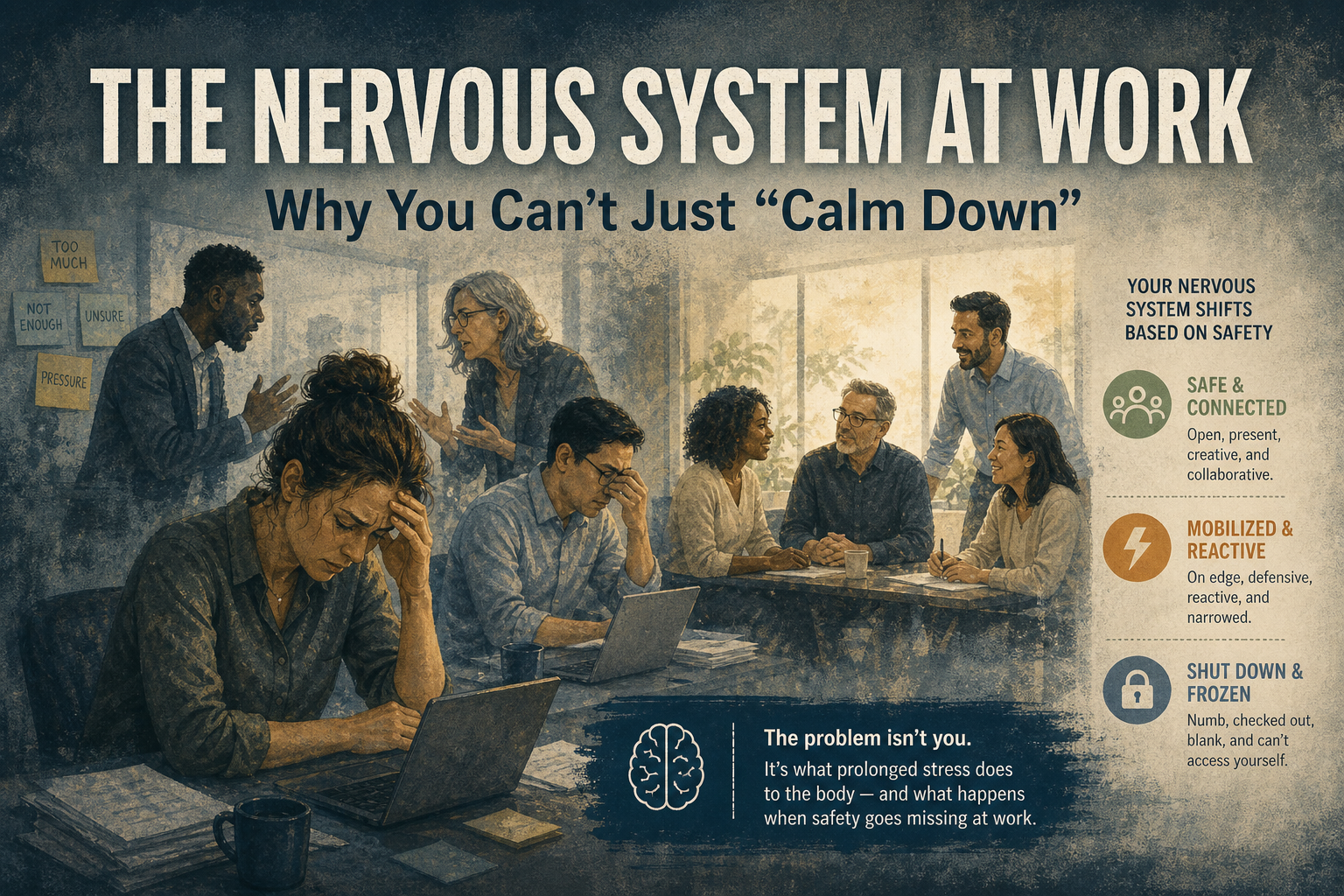
Porges describes three evolutionary circuits that engage unconsciously based on the nervous system’s perception of safety or danger. In plain language, they look something like this:
- Safe and connected. When the nervous system reads the environment as safe, we have access to our full range of social and cognitive capabilities. We can think creatively, listen generously, disagree productively, and regulate our own reactions in real time. This is the state in which good leadership, good collaboration, and good work happen.
- Mobilized and reactive. When threat is detected, the system shifts into fight-or-flight. Heart rate increases. Attention narrows. The body prepares for action. In this state, nuance is harder to access. We get reactive, defensive, or aggressive — not because we’re bad people, but because the system is doing exactly what it evolved to do. Collaboration and empathy become significantly harder. The prefrontal cortex — the part of the brain responsible for complex reasoning and impulse control — becomes less accessible.
- Shut down and frozen. When the system detects threat that feels inescapable — when mobilization hasn’t worked and there’s nowhere to go — it can shift into a kind of protective collapse. This looks like going blank in a meeting, being unable to speak up even when you want to, emotional numbness, or a pervasive flatness that doesn’t respond to rest. It can look a lot like not caring. It is almost never not caring.
Sound familiar? That colleague who explodes unpredictably. The team member who has gone completely flat. The leader who gets rigid and controlling under pressure. The person who freezes in conflict and can’t find their words until three hours later in the car. These aren’t personality defects. These are nervous systems doing their jobs in an environment that keeps signaling danger.
When the Threat Is the Building Itself
Here’s what makes chronic workplace stress different from ordinary acute stress — and why it’s so difficult to address with standard coping strategies.
In most models of stress response, the cycle is designed to complete. You detect a threat. Your system mobilizes. You respond. The threat resolves. You return to baseline. This is the natural arc.
But in a toxic or chronically stressful workplace, the threat doesn’t resolve. You go home, and tomorrow the same dynamics are waiting. The same unpredictable leader. The same imbalance of accountability. The same sense of being unsupported, unseen, or unsafe. The alarm system stays on — not at full emergency pitch, but at a persistent low-level activation that never fully returns to baseline.
Over time, this does something important: it recalibrates what the nervous system reads as normal. The chronic low-level alert stops feeling like alert and starts feeling like just how things are. And that recalibration has consequences — for sleep, for health, for cognition, and for the capacity to recognize that something is wrong in the first place.
Dr. Aimie Apigian, whose Biology of Trauma framework examines how the body stores and processes unresolved stress, describes this as the difference between stress and trauma. Stress is the activation. Trauma is what happens when the activation has nowhere to go — when the nervous system gets stuck in a state it can’t complete and can’t exit. Chronic workplace stress, particularly in environments where speaking up is unsafe or action feels impossible, creates exactly these conditions. The body absorbs what the situation won’t allow to be expressed or resolved.
This is why the exhaustion of burnout doesn’t lift after a weekend. Why the cynicism that develops in toxic environments can persist long after leaving them. Why people who were once high-functioning, energetic, and engaged can seem like entirely different people — not because they changed, but because their nervous systems adapted to an environment that required adaptation to survive it.
The Emotional Intelligence Blind Spot in Leadership
This has particular implications for leaders — and it’s one of the most under-discussed dynamics in leadership development.
Most leadership training focuses on the skills of emotional intelligence: empathy, communication, self-awareness, regulation. And those skills are real and learnable. But training them in calm conditions and then expecting them to be equally available under pressure is a significant oversight.
Research in high-stress occupational settings consistently finds that stress itself degrades performance on the very dimensions emotional intelligence is supposed to support — cognitive flexibility, interpersonal attunement, decision quality. A leader who has genuinely developed strong emotional intelligence capabilities may find those capabilities significantly less accessible when they are dysregulated, under threat, or chronically overwhelmed.
A leader operating from a mobilized, reactive nervous system state — even one who is fundamentally well-intentioned and normally self-aware — is more likely to be rigid, reactive, and less attuned to the impact of their behavior on others. They may raise their voice when they intended to stay calm. Withdraw when the team needed connection. Default to control when trust was what the moment called for. Miss the signals that someone on their team is struggling.
And here’s the part worth sitting with: they may have no reliable access to that self-awareness in the moment, because the part of the brain that generates it is less available when the system is under sustained threat.
This is not an excuse. Impact doesn’t disappear because the leader was stressed. But it is an explanation — and understanding it is the first step toward interrupting it.
DeKay’s research on Adverse Work Experiences points toward something important here: the chronic, everyday stressors that leaders often generate without recognizing them as stressors — the inconsistency, the unpredictability, the sense of unfairness — are precisely the conditions that keep other people’s nervous systems in a persistent state of low-level activation. Leaders operating from dysregulation tend to produce dysregulation in the people around them. It compounds. It spreads. And it becomes the culture.
What This Means for Recovery
If the nervous system is at the center of what happens in a toxic workplace — and if what looks like disengagement, emotional flatness, or diminished performance is often a regulated response to an unsafe environment — then recovery isn’t primarily a matter of willpower or resilience training.
It’s a matter of safety.
The nervous system cannot begin to restore itself in an environment it continues to read as threatening. This is why people who leave toxic workplaces often find that recovery takes longer than they expected — the system doesn’t immediately recognize that the threat has passed. And it’s why people who are still in those environments face such a steep climb: they’re being asked to regulate in conditions designed to dysregulate.
That doesn’t mean nothing can be done. There are practices — somatic, relational, and cognitive — that help move the nervous system toward more regulated states even within difficult environments. We’ll cover those in depth later in this series. But context matters. And the goal isn’t to help people withstand more harm. The goal is to help people understand what’s happening, take it seriously, and make informed decisions about what to do with that understanding.
The Tools
Tool 1: The State Check For individuals — building moment-to-moment awareness
You can’t regulate a state you haven’t noticed. The first practice is simply learning to identify which state you’re in — not as a judgment, but as information.
Several times a day — particularly before high-stakes conversations, after difficult interactions, or when you notice something feels off — pause and ask:
- Where am I right now? Connected and relatively clear? Activated and reactive? Flat, numb, or shut down?
- What does this state feel like in my body? (Tension, heaviness, racing heart, shallow breath, nothing at all?)
- Is this state a response to right now — or is it carrying something forward from earlier, or from a longer pattern?
You’re not trying to fix it yet. You’re just learning the landscape. That awareness alone begins to create a small gap between stimulus and response — and that gap is where choice lives.
Tool 2: The Co-Regulation Inventory For individuals and teams
Polyvagal Theory emphasizes that safety doesn’t emerge only from internal states — it is also communicated and transmitted between people. Co-regulation — the way one person’s regulated nervous system can help settle another’s — is real, and it matters in workplace contexts. THE ORG
Sit with these questions:
- Who in your workplace helps you feel more settled, clearer, more like yourself? What do they do that produces that?
- Who consistently activates your threat response — even in low-stakes interactions?
- Are there environments (physical spaces, meeting formats, times of day) where you consistently feel safer or more regulated?
This inventory isn’t about avoiding people or situations indefinitely. It’s about understanding your nervous system’s map of your workplace — so you can make more intentional choices about when to seek support, when to protect your resources, and when you have more capacity available than you realized.
Tool 3: The Leadership State Audit For leaders
Before your next significant interaction with your team — a one-on-one, a team meeting, a difficult conversation — take two minutes to check in with yourself honestly:
- What state am I bringing into this room?
- Am I activated right now — carrying pressure, frustration, or urgency that belongs to a different context?
- Is there anything I need to do first to arrive more regulated? (A short walk. A few slow breaths. A pause before entering the room.)
This is not about performing calm. It’s about recognizing that your nervous system state is contagious — that you set a tone the moment you walk in, before you’ve said a word. The most skilled thing a leader can do in a high-pressure moment is often to regulate themselves first.
We Want to Hear From You
Which of the following resonates most right now?
- I recognized myself or someone I know in one of those three states
- I’ve never thought about my stress response this way before — this reframes something
- I’m a leader and the state contagion piece is landing in an uncomfortable but useful way
- I’ve been trying to “calm down” and couldn’t — now I understand why a little better
Take the full survey: Better Than This — Community Research Survey – Fill out form Under 10 minutes. Fully anonymous. Your experience shapes what gets built next.
Coming Up in This Series
- The Lost Art of Listening: Why No One Feels Heard at Work
- Gaslighting at Work: When Reality Becomes a Moving Target
- What Actually Helps: Evidence-Based Strategies for Surviving a Toxic Workplace
- For Leaders: The Accidental Bad Boss
- Finding Your Way Out: Recovery, Resilience, and What Comes Next
References
- Apigian, A. (2023). The biology of trauma: How the body holds fear, pain, and overwhelm — and what heals it. Rodale Books. biologyoftrauma.com
- Dana, D. (2018). The polyvagal theory in therapy: Engaging the rhythm of regulation. W. W. Norton & Company.
- Giroux, C., Ahlers, D., & Miawotoe, A. (2023). Polyvagal approaches: Scientifically questionable but useful in practice. Journal of Psychiatry Reform, 10(11).
- Peaceful Living Mental Health Counseling. (2025, November). Emotional intelligence is nervous system intelligence. peacefullivingmentalhealthcounseling.com
- Porges, S. W. (2022). Polyvagal theory: A science of safety. Frontiers in Integrative Neuroscience, 16, 871227. https://doi.org/10.3389/fnint.2022.871227
- Porges, S. W. (2023). Our polyvagal world: How safety and trauma change us. W. W. Norton & Company.
- Porges, S. W. (2024). Polyvagal perspectives: Interventions, practices, and strategies. W. W. Norton & Company.
- Sanchez-Gomez, M., et al. (2026). Emotional intelligence training improves stress regulation and performance in high-stress occupations. Scientific Reports. https://doi.org/10.1038/s41598-026-36216-8
- DeKay, N. J. (2022). Adverse work experiences and the impact on workplace psychological wellbeing [Doctoral dissertation, Seattle Pacific University]. https://digitalcommons.spu.edu/iop_etd/35
If this is resonating and you want support making sense of what to do next — schedule a free discovery session →