
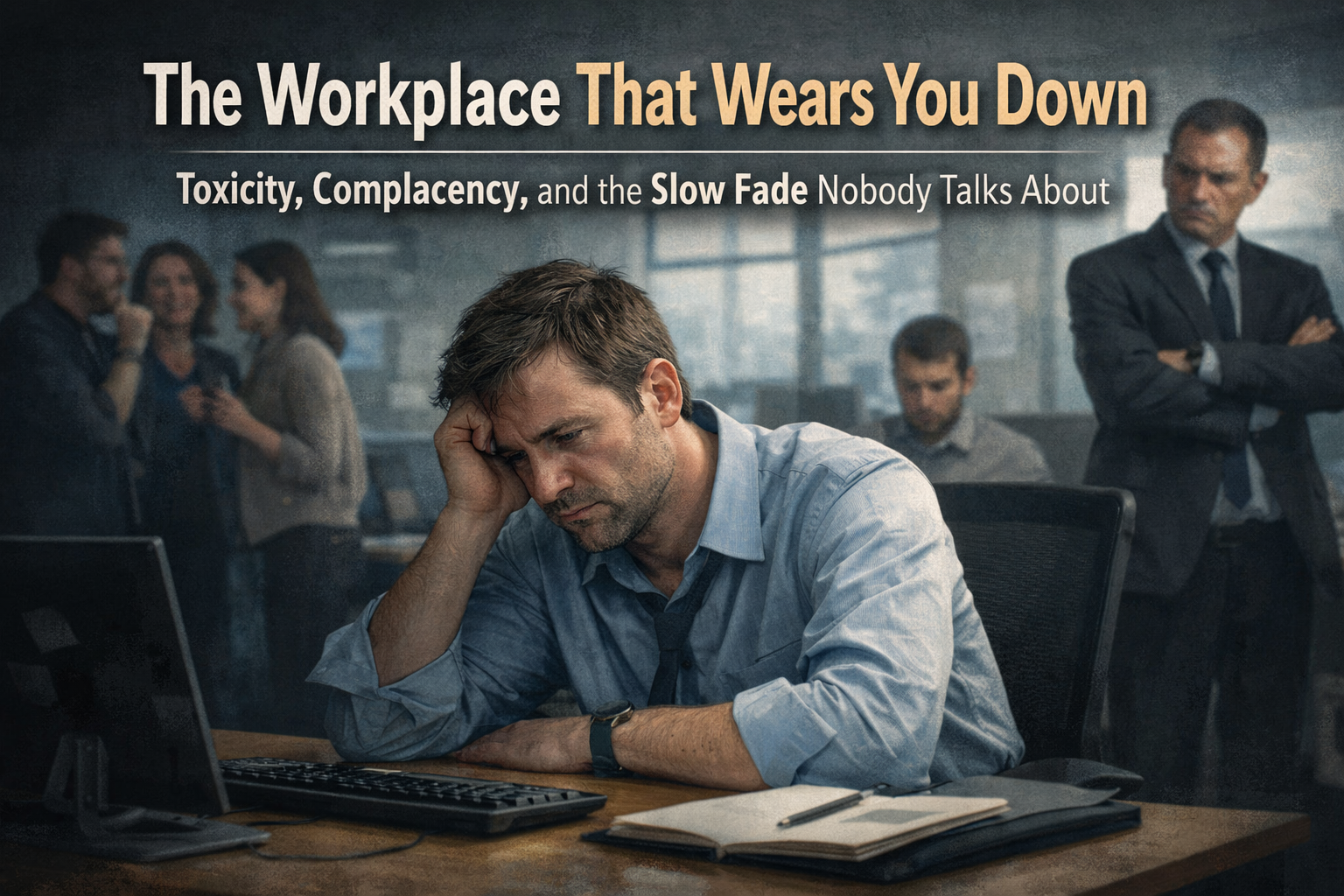
Article 1 in the Better Than This Series.
Picture someone you worked with — or work with now.
They came in with energy. They had ideas. They asked questions, pushed back when something didn’t make sense, stayed late because they actually cared about the work. Maybe they were a new hire. Maybe a newly promoted supervisor. Maybe just someone who genuinely loved what they did and it showed.
Now picture that same person six months later. A year later. 5 years. 10 years.
They still show up. They do their work. But the questions have stopped. The ideas have stopped. They’re present, but they’re not there. They respond when asked, but they’ve stopped volunteering. They do exactly what’s required and nothing more.
Here’s what that probably wasn’t: a motivational issue. A skills gap. Disengagement for no reason.
Here’s what it more likely was: a person who learned, through repeated experience, that showing up fully wasn’t safe.
That’s what a toxic workplace actually does. Not in a single dramatic incident — but through accumulation. Pattern by pattern. Comment by comment. Laugh by laugh.
It’s Rarely One Person. It’s a System.
When we talk about toxic workplaces, the conversation usually centers on one character: the bad boss. The difficult manager. The person at the top causing the damage.
And yes — leadership matters enormously. Poor leadership creates conditions where harm becomes possible.
But the bad boss alone doesn’t sustain a toxic environment. The people around the bad boss do.
Here’s an example that’s more common than it should be.
A coworker makes a comment about the inconvenience of parental leave — an eye-roll, a complaint, a joke at someone’s expense. Maybe the person it affects is in the room. Maybe they’re not. Maybe someone laughs. Nobody says anything. The comment lands and settles. The next week, someone else makes a similar remark. Again, no one pushes back. The pattern solidifies.
What has just been communicated to everyone in that room?
That this is acceptable here. That parental leave — and by extension, the person taking it — is a burden. That if you advocate for yourself, or need something, or exist outside the narrow definition of “ideal worker,” you’re a problem.
No policy was violated. No single person behaved in a clearly fireable way. And yet real harm was done.
Research on workplace incivility by Christine Porath consistently shows that the cumulative impact of these small moments — dismissiveness, exclusion, casual disrespect — measurably affects health, performance, and belonging. You don’t need a villainous boss to be in a genuinely harmful environment. You need a culture that tolerates small cruelties and calls it normal.
The Bystander Problem Nobody Wants to Talk About
There’s a reason patterns like this persist. And it’s uncomfortable to name, so let’s name it.
Silence is participation.
Not speaking up isn’t neutral. Not laughing, but not stopping it either, is not neutral. Watching someone get worn down, day after day, and doing nothing — because it’s not your fight, because it’s risky, because you’ve normalized it too — is not neutral.
The research on bystander behavior is consistent: people are far less likely to intervene when others are present. The more people in the room, the more everyone assumes someone else will say something. Nobody does. The behavior continues. The target absorbs the message that this is simply how it is here.
And here’s the piece that deserves more attention: who says something matters as much as whether anyone says something.
When the person being targeted speaks up — “hey, that’s not okay” — we expect it. It fits the pattern. The brain registers it as part of the existing dynamic: the person being picked on, defending themselves. It doesn’t disrupt anything. Sometimes it makes things worse.
But when someone who isn’t the target speaks up — especially someone who shares a characteristic with the person causing harm (title, tenure, gender, social standing) — something different happens. The pattern breaks. The brain notices. Everyone in that room has to pause and decide, individually, what they think about what just happened.
That pause is where change lives.
One Disruption Isn’t Enough. But It’s Where It Starts.
It’s worth being honest about this: one person saying “that’s not okay” probably won’t change a deeply entrenched culture. Patterns don’t form overnight, and they don’t change overnight. A culture that has spent years normalizing dismissiveness, overwork, or casual cruelty will not be transformed by a single moment.
But repeated disruptions? Those compound.
When one person says something, it signals to others that it’s possible. When two people say something, it starts to feel like a norm. When saying something becomes the expected response — when silence becomes the uncomfortable choice rather than speaking up — the pattern has shifted.
The goal isn’t a dramatic confrontation. It’s small, consistent friction against what’s being normalized. It’s asking a question in a meeting that the target couldn’t safely ask. It’s checking in privately: “Hey, that comment earlier — are you okay?” It’s declining to laugh. It’s saying, simply, “I don’t think that’s fair.”
None of these require heroism. All of them require a choice.
What Happens When No One Does Anything
Back to the person you pictured at the beginning.
The high performer who’s gone quiet. The engaged new hire who’s stopped asking questions. The manager who used to advocate for their team and now keeps their head down.
This is what chronic exposure to an environment that doesn’t protect you actually produces. Not a dramatic breakdown. Not a resignation letter. Just a slow, quiet retreat into the smallest, safest version of yourself that the job requires.
Christina Maslach’s foundational burnout research identifies what she calls depersonalization — a psychological distancing that develops when people are repeatedly exposed to stressors without adequate support or recovery. It’s not apathy. It’s protection. The person isn’t disengaged because they stopped caring. They’re disengaged because caring became too costly.
The American Institute of Stress reports that workplace stress is the leading source of stress for American adults, with significant downstream effects on physical health, mental health, and productivity. Most of that stress doesn’t come from the work itself — it comes from the environment in which the work happens.
And critically: systems that were never designed with everyone in mind make all of this worse. When the structures, norms, and unspoken rules of an industry or organization were built around a particular kind of worker — a particular set of circumstances, a particular life — people who don’t fit that mold carry a persistent extra burden. They work within systems that weren’t made for them. And when those systems produce harm, they’re less likely to be believed, less likely to have recourse, and more likely to absorb it quietly because they’ve learned that speaking up costs more than it returns.
This Series Is About That
Over the coming months, this series will go deep on what actually happens in toxic workplaces — the research behind it, the tools that help, and the honest conversation about what individuals, bystanders, and leaders can each do.
Not because it’s easy. Because it matters.
I’ve heard from colleagues, friends, clients – all in different roles, industries, states in their careers, with different responsibilities – how these things impact them, that they see them or experience them so frequently. And I believe we can all be BETTER THAN THIS.
If you’re the person who’s been fading, we want you to know: that fade is a rational response to an irrational situation. It is not who you are. And there are paths forward.
If you’re someone who’s been watching and doing nothing — we’re not here to shame you. Bystander silence is almost always about fear, uncertainty, or normalization, not cruelty. But we want to make it harder to stay silent, and easier to know what to do instead.
If you’re a leader wondering whether something here applies to you — that question alone is worth following.
Coming Up in This Series
- Burnout Is Not a Personal Failing: The Science of What’s Happening to You
- The Nervous System at Work: Why You Can’t Just “Calm Down”
- The Lost Art of Listening: Why No One Feels Heard at Work
- Gaslighting at Work: When Reality Becomes a Moving Target
- What Actually Helps: Evidence-Based Strategies for Surviving a Toxic Workplace
- For Leaders: The Accidental Bad Boss
- Finding Your Way Out: Recovery, Resilience, and What Comes Next
We Want to Hear From You
This series is being shaped, in part, by your experiences. Whether you’re in a toxic environment now, have left one, witnessed one from the side, or lead a team and want to reflect honestly — your perspective matters.
We’ve built a short research survey (under 10 minutes, fully anonymous) to better understand what people are actually experiencing, and most importantly, what’s actually helped.
Your responses will directly inform future resources, tools, and programs. The more people who respond, the more useful the findings will be.
References
- American Institute of Stress. (2023). Workplace Stress. stress.org
- Maslach, C., & Leiter, M. P. (2016). Burnout. In G. Fink (Ed.), Stress: Concepts, Cognition, Emotion, and Behavior. Academic Press.
- Porath, C., & Pearson, C. (2013). The price of incivility. Harvard Business Review, 91(1–2), 115–121.
- Latané, B., & Darley, J. M. (1970). The Unresponsive Bystander: Why Doesn’t He Help? Appleton-Century-Crofts.
- Brown, B. (2018). Dare to Lead. Random House.
If this resonates and you want support figuring out your next step — you don’t have to do it alone. Schedule a free discovery session →