
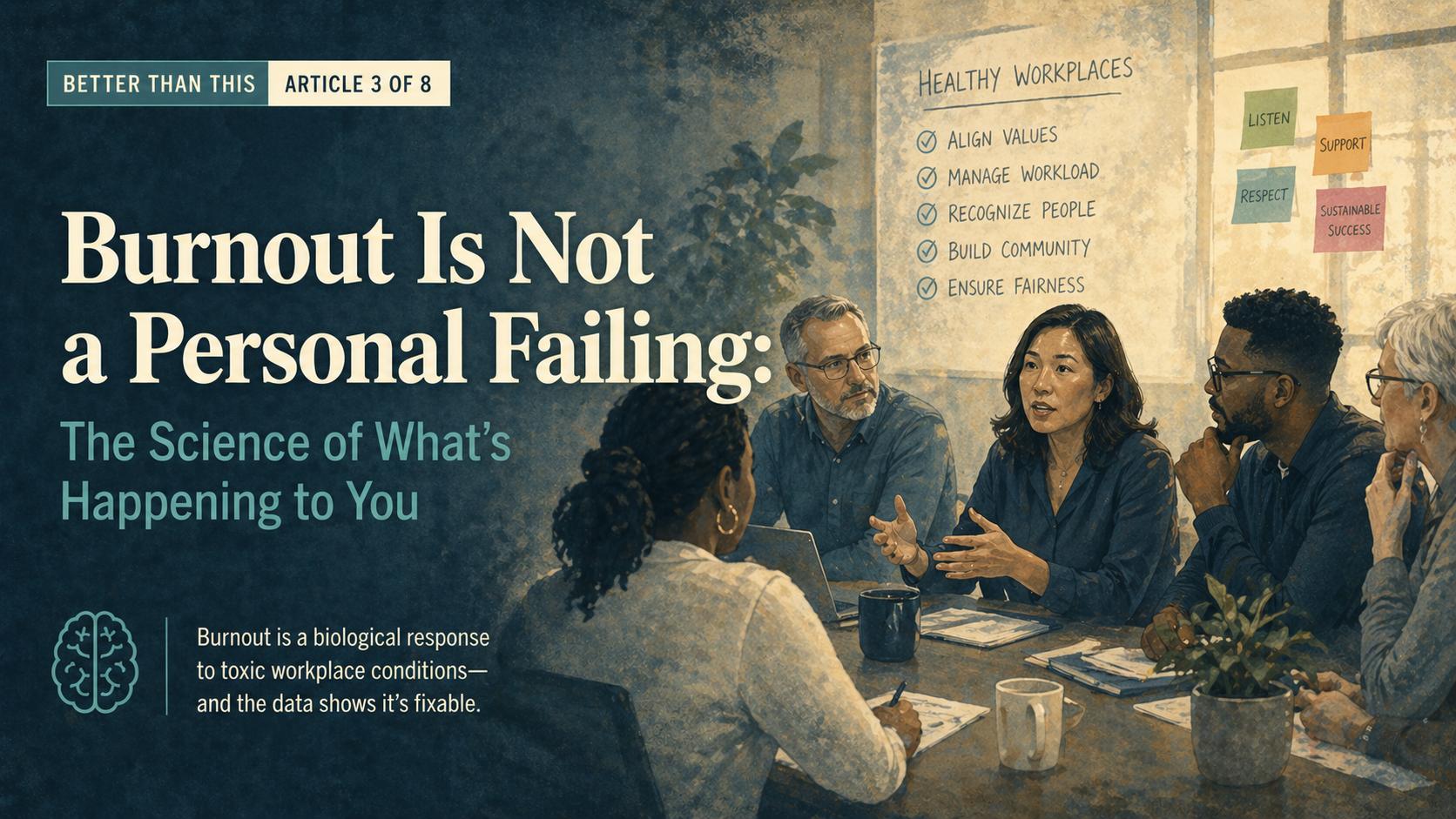
BETTER THAN THIS — Article 3 of 9
This is the third article in the Better Than This series on toxic workplace cultures — what they are, how they work, and what actually helps. If you’re new to the series, you may want to start with [Article 1: The Workplace That Wears You Down →] or [Article 2: “It’s Not That Bad” →]
You’ve probably said it, or heard someone say it: I just need a vacation. I need to push through. I need to toughen up.
Maybe you’ve taken the vacation. Maybe you’ve pushed through. And if you’re honest, neither really worked — not in the way you needed it to. You came back from the time off and within a week felt exactly the same. You pushed through and the fatigue didn’t lift; it just went somewhere deeper.
That’s not a character flaw. That’s not weakness. That’s not a motivational problem.
That’s burnout. It’s not just in your head – it’s in your biology.
What Burnout Actually Is
The term gets used loosely enough that it’s worth outlining what the research actually says.
Burnout has been studied in occupational health for fifty years. Since the publication of the Maslach Burnout Inventory (MBI) in 1981, researchers have largely defined it by three core dimensions: exhaustion, cynicism, and inefficacy. ResearchGate
These aren’t just words for feeling tired or discouraged. They describe a specific pattern of deterioration that develops under sustained, unresolved workplace stress — and each dimension tells a different part of the story.
Exhaustion refers to the depletion of emotional resources — the point at which workers feel they are no longer able to give of themselves at a psychological level. Cynicism (sometimes called depersonalization) describes the development of negative, detached attitudes toward work and colleagues — a distancing that begins as self-protection and can harden into something that feels like not caring at all. Reduced efficacy — the third dimension — refers to a growing sense of failure and inadequacy, a tendency to evaluate yourself negatively, and dissatisfaction with what you’re producing. Frontiers
Importantly, these dimensions don’t always arrive together, and they don’t always arrive at the same pace. You might be deeply exhausted long before the cynicism sets in. The erosion of your sense of competence might feel like the most devastating part, even when your output hasn’t changed much. Research suggests that only 10–15% of employees align with a full burnout profile across all three dimensions — but many more are caught in partial patterns: overextended, disengaged, or ineffective — each of which deserves attention, not dismissal. DOI
It’s Not Stress. It’s Not Depression. It’s Not Laziness.
You’ve probably said it, or heard someone say it: I just need a vacation. I need to push through. I need to toughen up.
Maybe you’ve taken the vacation. Maybe you’ve pushed through. And if you’re honest, neither really worked — not in the way you needed it to. You came back from the time off and within a week felt exactly the same. You pushed through and the fatigue didn’t lift; it just went somewhere deeper.
That’s not a character flaw. That’s not weakness. That’s not a motivational problem.
That’s burnout — and it has a biology.
It’s not stress. Stress, broadly speaking, is a response to too much — too many demands, too little time. In its acute form, it’s adaptive. The nervous system mobilizes, you respond, the demand eases, and you recover. That cycle is what stress is designed to do.
Burnout is what happens when the cycle doesn’t complete. When the stressor doesn’t ease. When you can’t take meaningful action to address what’s causing the pressure — because the source is structural, institutional, or simply not within your control. Polyvagal theory, developed by Dr. Stephen Porges, helps explain what happens in the nervous system under these conditions: when the body detects ongoing threat but has no effective response available, it moves out of the social engagement and active mobilization states and into something more like shutdown — a freeze or collapse response that conserves resources but significantly impairs functioning.
That shutdown isn’t weakness. It’s your nervous system doing the only thing left available to it.
And here’s what makes this relevant to burnout: trauma — in the clinical sense — is not defined by the severity of an event. It’s defined by what happens when the nervous system is overwhelmed and cannot complete its response. Chronic, unresolvable stress that offers no outlet, no relief, and no sense of control creates exactly those conditions. Burnout, in this light, isn’t just accumulated fatigue. It may be the embodied result of chronic overwhelm — a nervous system that has been trying to respond to threat for a very long time and has run out of resources to keep doing so.
It may not be depression — though the relationship is worth being honest about. Burnout and depression share features: loss of interest, impaired concentration, emotional exhaustion. Researchers continue to debate the degree of overlap. McKinsey & Company A key distinction is that burnout tends to be cause-specific — tied to work-related stressors — and symptoms may ease when those conditions change. Depression typically requires more structured treatment even when external stressors shift. PubMed Central That said, research suggests a potential pathway: chronic work stress can lead to burnout which, when unaddressed, may develop into clinical depression. Frontiers If you’re noticing symptoms that extend well beyond work — persistent sadness, loss of interest in things you valued outside the job, changes in sleep or appetite, thoughts of self-harm — please talk to a mental health professional. These deserve direct attention, not just workplace interventions.
And it is definitively not laziness. Maslach identifies specific mismatch areas that create conditions for burnout: work overload, lack of control, inadequate recognition, breakdown of community, lack of fairness, and conflicting values. candidcc These are structural and systemic conditions. When they’re present, burnout isn’t a personal failure — it’s a predictable outcome.
The Workplace as the Origin
This is the piece that often gets lost in conversations about burnout — particularly when those conversations focus on individual resilience, self-care, and coping strategies.
Burnout is not, at its core, a problem with the individual. It is a problem with the environment.
Dr. Nicole DeKay, an industrial-organizational psychologist whose doctoral research focused on what she calls Adverse Work Experiences (AWEs), makes this distinction with particular clarity. Her research studied how the presence of adverse work experiences — both acute and chronic — impact mental health in terms of workplace psychological distress and wellbeing, and found that AWEs were significantly related to higher psychological distress, lower psychological wellbeing, higher turnover intention, lower engagement, and lower levels of work conscientiousness. candidcc
What makes DeKay’s framing valuable here is the breadth of what she categorizes as adverse. It isn’t limited to dramatic, reportable incidents. It includes the everyday psychological stressors that accumulate without ever triggering a formal response — the chronic low-level experiences that organizations largely overlook because they don’t rise to the level of a safety incident or an HR complaint.
Sound familiar?
DeKay also adapted the PTSD symptom checklist for workplace contexts — reframing clinical trauma indicators as workplace experiences — and found that nearly 25% of her sample showed a psychological distress response resembling traumatic stress. PubMed Central This is not a fringe finding. One in four people in her sample. Not from war zones or emergency rooms — from workplaces.
She has also written about the normalization of “do more with less” — a management pattern she describes as one that stretches the rhetoric but breaks the reality, and identifies it as one of the greatest predictors of turnover. ScienceDirect Not because people are fragile. Because systems that consistently demand more than they support are systems that will eventually deplete the people within them.
What Happens to the Body
Burnout isn’t only psychological. It has a physiology — and understanding it matters, because it explains why pushing through rarely works.
Chronic exposure to workplace stressors activates the body’s stress response system — the hypothalamic-pituitary-adrenal (HPA) axis, which releases cortisol to mobilize energy for response. Under acute stress, this is adaptive. Under chronic, unresolvable stress, the system stays activated. Over time, sustained cortisol elevation is associated with disrupted sleep, impaired immune function, cardiovascular strain, and changes in memory and concentration.
But the physiological story goes deeper than cortisol.
Dr. Aimie Apigian, whose work on the Biology of Trauma examines what happens in the body when stress becomes stored rather than resolved, describes trauma not as an event but as a physiological state — one in which the nervous system has been overwhelmed past its capacity to return to baseline on its own. Her framework, along with Polyvagal Theory, helps explain why the exhaustion of burnout is qualitatively different from ordinary tiredness. The body is not simply fatigued. It is holding a sustained state of incomplete threat response. Rest, in that condition, isn’t fully restorative — because the system hasn’t been signaled that it’s safe to fully recover.
This is why the advice to “just manage your stress better” lands so inadequately for people in genuinely toxic environments. Nervous system regulation tools — breathwork, movement, somatic practices — can provide real relief, and we’ll explore those in depth in the next article. But they cannot resolve a structural problem. Telling someone to meditate their way out of an environment that is actively producing harm is like telling someone to breathe deeply while the building fills with smoke. The breathing matters. It is also not the point.
If you want to explore these frameworks further, Dr. Apigian’s work is accessible at biologyoftrauma.com, and Deb Dana’s writing on Polyvagal Theory in applied contexts is a readable entry point for anyone new to that framework.
The Slow Fade, Revisited
In the first article in this series, we talked about the high achiever who goes quiet — the person who used to have ideas, ask questions, push back, and now keeps their head down and does exactly what’s required.
Burnout is often what’s underneath that.
People with burnout find their jobs increasingly stressful and frustrating. They become cynical about their working conditions and colleagues, distance themselves emotionally, and show less interest in their work. This is not disengagement from apathy. This is disengagement as protection — the mind and body doing what it can to conserve what’s left.
Reduced personal accomplishment — the third dimension of the Maslach model — is perhaps the cruelest part of this pattern for people who are highly capable and motivated. The very people most invested in doing good work are often the most devastated by the growing sense that they can no longer do it well. They don’t stop caring. They start believing, after enough exposure to an environment that hasn’t supported them, that their capacity to contribute has genuinely diminished.
It usually hasn’t. The environment has made it unsafe to do so.
For Leaders: What the Data Is Telling You
If you’re a leader reading this, burnout in your team has organizational consequences that are measurable and significant. Research shows burnout reduces engagement and focus, increasing absenteeism, presenteeism, and turnover — and can cost organizations up to 18–20% of total output. ScienceDirect Nearly half of burned-out U.S. workers are actively seeking new jobs. ScienceDirect
But the more important question is the human one.
There’s a pattern in peer support work with first responders that translates directly here. It’s called administrative or institutional stress — the stress that comes not from the work itself, but from the bureaucracy surrounding it. Policies that don’t make sense. Leadership decisions that feel arbitrary or unfair. The weight of politics, outside pressures, and the persistent sense that the organization you’re working for doesn’t have your back.
In first responder culture, this kind of stress is often identified as more damaging over time than the stress from a critical incident. Not because the incident is less serious — it isn’t. But a critical incident has an end. It can be named. There are established protocols for support in its aftermath. People expect that something significant happened and that those involved may need help.
Administrative stress doesn’t work that way. It’s chronic. It accumulates in small increments — a policy change here, a decision that lands badly there, a consistent sense of being unsupported that no one incident fully explains. It’s hard to point to and say that’s where the stress is coming from. It’s hard to ask for support because you’re probably not the only one affected — which means others probably need the help more than you. You’re tough. You can keep pushing through. It will get better eventually. It’s just a stupid policy, a bad boss, a rough quarter.
Until it isn’t.
Until the bump in the road becomes a well you can’t seem to climb out of.
This is exactly the territory DeKay’s research on Adverse Work Experiences illuminates. The chronic, hard-to-name stressors that organizations don’t formally track are producing distress responses in measurable portions of the workforce. Not because people aren’t resilient. Because systems that consistently ask more than they support will eventually deplete the people within them.
The question for leaders isn’t are my people resilient enough? It’s what am I asking them to absorb — and have I acknowledged any of it?
The Tools
Tool 1: The Burnout Scan For individuals
The Maslach Burnout Inventory is a validated research instrument — the most widely used burnout measure in the world. While the full instrument requires a licensed assessment, you can use the three dimensions as a personal reflection framework:
Sit with these questions honestly — not to diagnose yourself, but to orient where you are:
- Exhaustion: How depleted do I feel — not just physically, but emotionally? Does rest restore me, or does the fatigue persist?
- Cynicism: Have my feelings toward my work, my colleagues, or my organization shifted? Am I more detached, more negative, more indifferent than I used to be? Does that feel chosen, or has it crept up on me?
- Efficacy: How do I feel about the quality of my contributions right now? Has my confidence in my own competence changed — and if so, when did that start?
You’re not looking for a score. You’re looking for a pattern — and for how long it’s been present.
Tool 2: The Condition vs. Character Check For individuals
Burnout erodes self-trust. One of its most insidious effects is convincing you that what you’re experiencing reflects something true about who you are — your capability, your resilience, your worth.
When you notice a thought like I can’t handle this anymore or I used to be better at this, try adding one question: Is this about me, or about the conditions I’m in?
This isn’t about making excuses. It’s about accurate attribution. If you’ve been operating in an environment marked by the conditions DeKay and Maslach both describe — chronic overload, lack of recognition, fairness deficits, erosion of community — your response to those conditions is not the same as your character.
Write it down if it helps. “I am noticing [exhaustion/cynicism/reduced efficacy]. This started approximately [when]. The conditions in my environment during this period have included [specific observations].”
Specificity interrupts the shame spiral. It also gives you useful information about what might need to change.
Tool 3: The Sustainability Audit For leaders
Before your next team check-in, sit with these questions:
- What am I currently asking of my team that isn’t sustainable at this pace?
- Where are workloads concentrated, and is that distribution fair?
- What recognition have I provided in the last month — specific, sincere, and publicly visible?
- What has my team been asked to absorb that I haven’t acknowledged?
- If I asked each person on my team privately whether they feel supported, what do I think they’d say?
You don’t need to share your answers. But if any of them are uncomfortable, that discomfort is data — and it’s pointing somewhere worth following.
We Want to Hear From You
Which of the following best describes where you are right now?
- I’m in it — exhausted, disconnected, and running on empty
- I’ve been here before and I’m still rebuilding
- I’m watching someone I care about go through this
- I lead a team and some of this is landing uncomfortably
- I’m not sure yet — but this is resonating
Take the full anonymous survey → Under 10 minutes. Your experience helps shape the resources we’re building.
Coming Up in This Series
- The Nervous System at Work: Why You Can’t Just “Calm Down”
- The Lost Art of Listening: Why No One Feels Heard at Work
- Gaslighting at Work: When Reality Becomes a Moving Target
- What Actually Helps: Evidence-Based Strategies for Surviving a Toxic Workplace
- For Leaders: The Accidental Bad Boss
- Finding Your Way Out: Recovery, Resilience, and What Comes Next
References
- Bianchi, R., Swingler, G., & Schonfeld, I. S. (2024). Burnout: Fifty years later. Work, Health, Journal of Occupational and Environmental Medicine, 21650799241260441. https://doi.org/10.1177/21650799241260441
- DeKay, N. J. (2022). Adverse work experiences and the impact on workplace psychological well being, workplace psychological distress, employee engagement, turnover intention, and work state conscientiousness [Doctoral dissertation, Seattle Pacific University]. Digital Commons @ SPU. https://digitalcommons.spu.edu/iop_etd/35
- Koutsimani, P., Montgomery, A., & Georganta, K. (2019). The relationship between burnout, depression, and anxiety: A systematic review and meta-analysis. Frontiers in Psychology, 10, 284. https://doi.org/10.3389/fpsyg.2019.00284
- Leiter, M. P., & Maslach, C. (2016). Latent burnout profiles: A new approach to understanding the burnout experience. Burnout Research, 3, 89–100.
- Maslach, C., Jackson, S. E., & Leiter, M. P. (1996). Maslach Burnout Inventory manual (3rd ed.). Consulting Psychologists Press.
- Maslach, C., & Leiter, M. P. (2016). Understanding the burnout experience: Recent research and its implications for psychiatry. World Psychiatry, 15(2), 103–111.
- Meditopia for Work. (2026). Employee burnout statistics 2026: Global & workplace insights. https://meditopia.com/en/forwork/articles/employee-burnout-statistics
- National Library of Medicine / InformedHealth.org. (2024, April 15). Depression: What is burnout? https://www.ncbi.nlm.nih.gov/books/NBK279286/
If this is landing close to home and you want support figuring out your next step — schedule a free discovery session →