
BETTER THAN THIS — ARTICLE 2 OF 9
This is the second article in the Better Than This series on toxic workplace cultures — what they are, how they work, and what actually helps. If this is your introduction to the series, you may want to start with Article 1: The Workplace That Wears You Down →
This is not a new conversation.
Researchers have been documenting workplace microaggressions, systemic exclusion, and the harm caused by bystander silence for decades. Derald Wing Sue, whose foundational work defined microaggressions as the everyday verbal, behavioral, and environmental indignities that communicate hostile or derogatory messages toward marginalized groups, published his landmark framework in 2007. The concepts of allyship, psychological safety, and inclusive culture have been discussed, debated, and trained on for years.
And yet.
A 2024 systematic review and meta-analysis of nearly 3,000 workers found that the overall prevalence of workplace microaggressions was approximately 73% (Salimi et al., 2024).
Not in some other decade. Now.
After a brief dip in 2023, women in 2024 reported a sharp increase in demeaning workplace interactions (LeanIn.Org & McKinsey, 2024). Women with disabilities were approximately 2.5 times more likely than their colleagues to report having their ideas taken by others or being mistaken for someone more junior (LeanIn.Org & McKinsey, 2024).
We know the problem. We’ve named it. We’ve trained on it. And it’s getting worse.
So maybe the question isn’t whether we understand what microaggressions are. Maybe the question is why understanding them hasn’t been enough to stop them.
What a Microaggression Actually Is
The term gets misused enough that it’s worth grounding it clearly.
Microaggressions are not simply rudeness or bad days. They are brief, commonplace verbal, behavioral, or environmental indignities — whether intentional or unintentional — that communicate hostile, derogatory, or negative messages toward people from marginalized groups (Sue et al., 2007).
The “micro” is misleading. It implies smallness. It implies manageability. What it actually refers to is frequency and subtlety — not impact.
The consequences for the person on the receiving end are well documented: diminished wellbeing, lower job satisfaction, and reduced career progression (Ong et al., 2013). Research using longitudinal measures found that repeated exposure to microaggressions leads to emotional exhaustion over time — a core component of burnout that signals resource depletion (Torres et al., 2024).
They compound. They accumulate. And they are often delivered — as the research consistently notes — without the explicit awareness of the person causing them.
That last part matters — and we’ll come back to it.
What It Actually Looks Like
Here are two scenarios. They are composite. They are also not unusual.
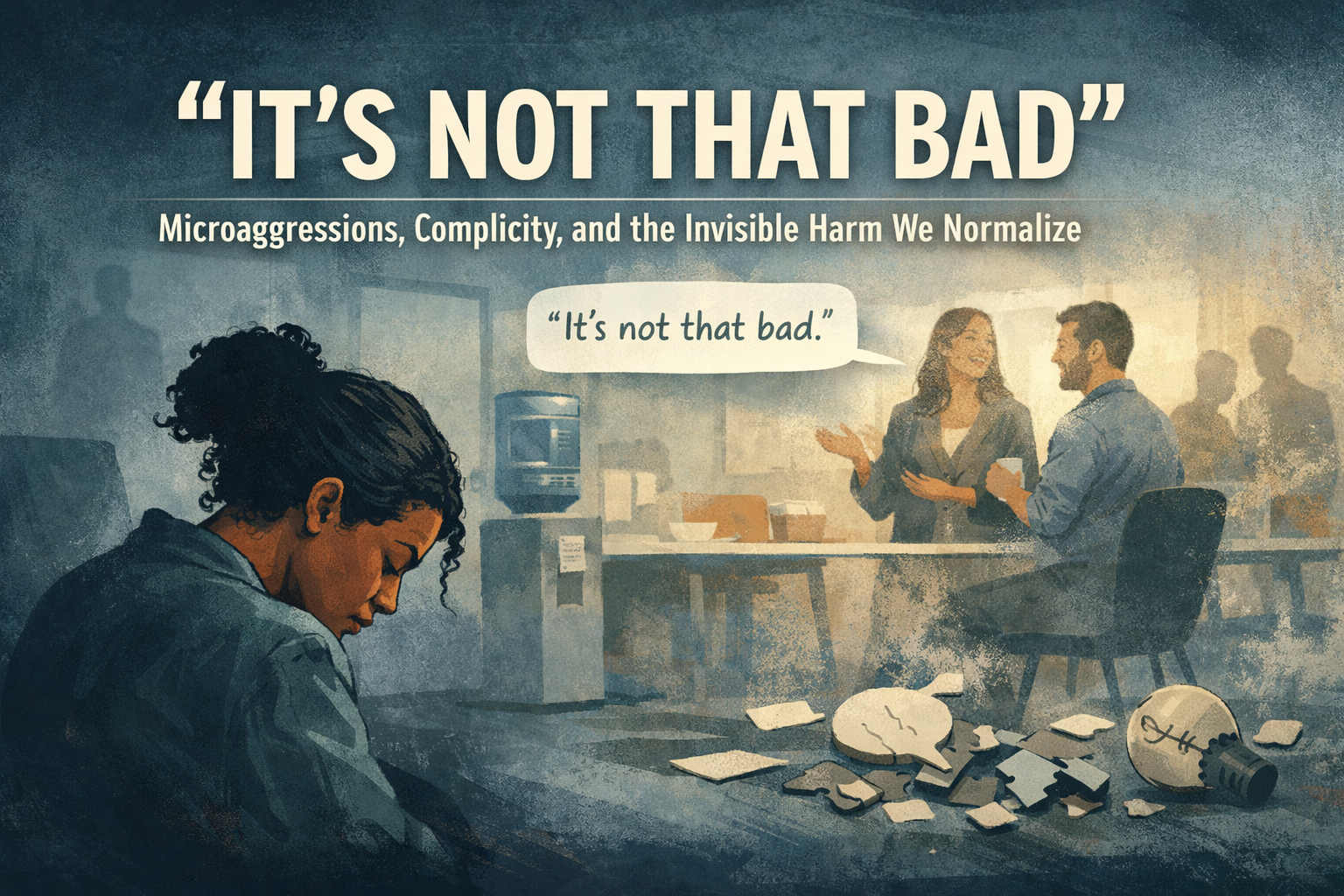
The meeting room. A woman is the only person in her demographic in a room of colleagues. She raises a point. The conversation moves on. Twenty minutes later, a male colleague makes the same point. The room responds. He’s credited with the insight. She notices. She’s noticed before. She says nothing — because she’s learned what happens when she does. She’s been told she’s “too sensitive.” That she “misread the situation.” That he “probably just didn’t hear” her the first time. After enough repetitions of this, she stops raising points in that room. Not because she has nothing to say — but because the cost of being ignored, or having her perception questioned, has become too high.
The implementation meeting that didn’t happen. A support staff member with years of institutional knowledge is not included in planning conversations for a new system rollout. The people in those conversations have titles. They have authority. They make decisions. When the system goes live and begins producing problems, it falls to the support staff member to identify them — problems that were entirely predictable to anyone who understood how the work actually functions. They spend weeks cleaning up a situation they were never given the chance to prevent. This isn’t incompetence. This is a system that structured them out of decisions that directly affect their work, and then held them accountable for the results.
Neither of these scenarios involves a single, obvious villain. Neither would likely be flagged in an HR complaint. Both are harmful. Both are common.
Research consistently notes that microaggressions are often covert and frequently unintentional — yet their consequences remain real and significant for those on the receiving end (Sue et al., 2007; Ong et al., 2013).
The Training Problem
Here’s something worth sitting with.
You’ve probably been in a harassment or discrimination training. Maybe several. Maybe you’ve even rolled your eyes — or been in a room where someone else did. Where someone muttered about how ridiculous this is, how they’ve done it a hundred times, how they already know all of this.
Here’s what that person missed.
They passed the test on overt discrimination. They know not to use slurs. They know what quid pro quo means. They know the obvious lines.
What research shows — and what organizations are increasingly recognizing — is that awareness of microaggressions and bias requires a fundamentally different kind of training than awareness of overt discrimination. Because microaggressions don’t announce themselves. They don’t feel like violations to the person committing them. They feel like normal conversation, reasonable assumptions, harmless jokes.
And to the person on the receiving end — who has been receiving them, in that form or a dozen similar forms, for years — they feel like something else entirely.
The people sighing through the training are often, without realizing it, the people the training is about. Not because they’re cruel. Because they haven’t had to notice. Because the environment has never required them to.
If you have not been a member of a marginalized group in your workplace, there are experiences in that room you have simply not had. Not because you’re unaware or unkind — but because the environment doesn’t create them for you. You can leave the training and return to a workplace that, structurally, mostly works for you.
What if you couldn’t do that? What if every environment you’d ever worked in had the same dynamics, because those dynamics are embedded in the industry, not just the workplace? What if leaving wasn’t a realistic option — because of geography, financial responsibilities, credentials that only transfer within the same sector, or simply because experience has taught you that there isn’t anywhere meaningfully better?
That’s not a hypothetical for a lot of people. That’s Tuesday.
Why Silence Isn’t Neutral
Research argues that the responsibility for creating just, inclusive workplaces belongs to everyone — and must be embedded in every practice, policy, and decision, not treated as the work of the people being harmed (Collins et al., 2021).
And yet the burden almost always falls on the person being harmed.
The target is expected to speak up. To document. To report. To educate. To be gracious while doing all of this. And when they finally do speak up — when they say, clearly, “that’s not okay” — the response is often skepticism, minimization, or the quiet suggestion that they’re making things difficult.
Meanwhile, others in the room remain silent. That silence isn’t neutral.
Bystander intervention — when it happens — can validate targets’ experiences and meaningfully reduce their sense of isolation, particularly in environments where group silence has become the norm (Jennings et al., 2026). Allyship research provides further evidence that when people from majority groups actively support marginalized colleagues, it can improve inclusion outcomes in measurable ways (Collins et al., 2021).
In other words: it matters who says something.
When the person being targeted speaks up, it fits the expected pattern. The brain processes it as part of the existing dynamic. When someone who isn’t the target — someone who shares characteristics with the group causing harm, or who holds more social capital in that room — says “that’s not okay,” something different happens. The pattern breaks. People are forced to make a new decision about what’s normal here.
That moment of discomfort? That’s where culture begins to shift.
One intervention probably won’t change much. Research on bystander training consistently finds that behavioral change requires repetition and practice — a single disruption of the pattern is rarely enough on its own (Frontiers in Psychology, 2025). The pattern has been building for a while. It will take a while to change. But repeated disruptions compound. When one person says something, others see that it’s possible. When two people say something, it starts to look like a norm. Eventually, silence becomes the uncomfortable choice — not the intervention.
That’s the shift worth working toward.
For Leaders: What You May Not Be Seeing
If you manage a team, this section is for you — not as criticism, but as a genuine question worth sitting with.
Is there someone on your team who used to contribute more than they do now? Who used to have ideas, ask questions, push back? Who now completes their work but rarely volunteers anything beyond what’s required?
There’s a reasonable chance that person didn’t change. Their environment changed what felt safe.
Research on microaggressions in professional settings finds that those who experience them frequently are more likely to report imposter phenomenon — a diminished sense of their own competence and legitimacy — as well as perceptions of inequity in pay and promotion (Myers et al., 2023).
These effects don’t stay at work. They follow people home. They shape how someone sees themselves over time. And they are often invisible to the people who weren’t their target.
The question worth asking isn’t just “Am I doing anything harmful?” It’s “Am I creating conditions where others feel safe enough to tell me if something is?”
The Tools
These aren’t fixes. Toxic patterns don’t have single-step solutions. But they’re grounded in what the research and lived experience suggest actually helps — and they’re designed to be usable now, without waiting for the environment to change first.
TOOL 1: THE PATTERN LOG — FOR PEOPLE EXPERIENCING MICROAGGRESSIONS OR EXCLUSION
Your perception is real. But when an environment consistently reframes your experience — “you misread it,” “that’s not what was meant,” “you’re being too sensitive” — it becomes harder to trust your own observations over time. A pattern log is a reality anchor, not an evidence file.
Keep it simple. A notes app or a small notebook works. After any incident that leaves you unsettled, write down:
- What happened, as specifically as possible — what was said, who was there, what the response was
- How you responded, and how you felt
- Whether it’s happened before, and in what form
Review it monthly, not daily. You’re looking for patterns — not replaying individual moments. Patterns tell the true story of an environment in a way that isolated incidents don’t.
TOOL 2: THE BYSTANDER PAUSE — FOR PEOPLE WHO WITNESS HARM AND AREN’T SURE WHAT TO DO
The barrier to intervention is rarely a lack of values — it’s a lack of a ready response in a moment that moves fast. Having language prepared in advance lowers that barrier significantly.
A few phrases worth having ready:
- “Actually, I think she raised that point first — can we go back to it?”
- “I want to make sure I understood that comment — can you say more about what you meant?”
- “That landed a little off for me. I don’t think that’s what we’re going for here.”
- “Hey, I noticed what happened in there. Are you okay?” (said privately, afterward)
None of these require certainty that harm occurred. They just introduce friction — a pause in the pattern that invites everyone in the room to make a fresh decision about what’s normal here.
TOOL 3: THE INCLUSION AUDIT — FOR LEADERS
This isn’t a formal process — it’s a set of honest questions to sit with regularly, ideally quarterly.
- Who speaks in your team meetings? Who doesn’t? Has that changed over time?
- Whose ideas move forward? Are they consistently coming from the same people?
- Who gets included in planning conversations — particularly before decisions that affect others’ work?
- When something goes wrong, who absorbs the accountability? Is that consistent with who had input?
- If you asked your quietest team member whether they feel heard, what do you think they’d say?
You don’t need to answer these out loud or share them with anyone. But if the answers are uncomfortable, that discomfort is worth following rather than moving past.
What You Can Do
If you’re the person being worn down:
- Name patterns for yourself, specifically. “In the last three team meetings, I raised X and it was not acknowledged. When a colleague raised the same point, it was.” Specificity is grounding when the environment wants you to question your own perception.
- Find at least one person who sees it — someone who can reflect reality back to you. One person outside the dynamic matters more than it might seem.
- Recognize that pulling back can be a protective response, not a personal failure. If you’ve slowed down or stopped fighting in the way you used to, that’s your system protecting itself. It doesn’t mean you’re broken. It means you’ve been absorbing something for a long time.
If you’re a bystander:
- You don’t need a speech. Simple and immediate is enough: “I don’t think that landed right.” “Actually, I heard her say that first.” You’re not adjudicating a case. You’re disrupting a pattern.
- Doing it once isn’t enough. But doing it once is still worth doing. Start there.
- Check in privately afterward. “Hey, I noticed that. Are you okay?” can matter more than a public defense.
We Want to Hear From You
Which of the following is most true for you right now?
- I’ve experienced what this article describes and I’m still in it
- I’ve been through it and I’m on the other side
- I’ve watched it happen to someone else and didn’t always know what to do
- I’m a leader and some of this made me uncomfortable in a way I want to sit with
- All of the above, at different points
Whatever your answer — take the survey here → Under 10 minutes. Your experience helps shape the resources we’re building.
Coming Up in This Series
- Burnout Is Not a Personal Failing: The Science of What’s Happening to You
- The Nervous System at Work: Why You Can’t Just “Calm Down”
- The Lost Art of Listening: Why No One Feels Heard at Work
- Gaslighting at Work: When Reality Becomes a Moving Target
- What Actually Helps: Evidence-Based Strategies for Surviving a Toxic Workplace
- For Leaders: The Accidental Bad Boss
- Finding Your Way Out: Recovery, Resilience, and What Comes Next
References
Collins, J. C., Zhang, P., & Sisco, S. (2021). Everyone is invited: Leveraging bystander intervention and ally development to cultivate social justice in the workplace. Human Resource Development Review, 20(4), 486–511. https://doi.org/10.1177/15344843211040734
Frontiers in Psychology. (2025). Bystander interventions against gender-based violence and harassment in the workplace: A scoping review. Frontiers in Psychology, 16. https://doi.org/10.3389/fpsyg.2025.1570812
Jennings, R., et al. (2026). Bridging bystander intervention and workplace inclusion: The critical role of perceived fairness, support, and safety. Journal of Organizational Behavior. https://doi.org/10.1002/job.70069
LeanIn.Org & McKinsey & Company. (2024). Women in the workplace 2024. https://leanin.org/women-in-the-workplace
Myers, A. K., Williams, M. S., & Pekmezaris, R. (2023). Intersectionality and its impact on microaggression in female physicians in academic medicine. Women’s Health Reports, 4(1), 298–304. https://doi.org/10.1089/whr.2022.0101
Ong, A. D., Burrow, A. L., Fuller-Rowell, T. E., Ja, N. M., & Sue, D. W. (2013). Racial microaggressions and daily well-being among Asian Americans. Journal of Counseling Psychology, 60(2), 188–199. https://doi.org/10.1037/a0031736
Salimi, N., et al. (2024). Prevalence of workplace microaggressions and racial discrimination: A systematic review and meta-analysis. Safety and Health at Work, 15(3), 261–268. https://doi.org/10.1016/j.shaw.2024.05.002
Sue, D. W., Capodilupo, C. M., Torino, G. C., Bucceri, J. M., Holder, A. M. B., Nadal, K. L., & Esquilin, M. (2007). Racial microaggressions in everyday life: Implications for clinical practice. American Psychologist, 62(4), 271–286. https://doi.org/10.1037/0003-066X.62.4.271
Torres, L., Taknint, J. T., & Bubar, R. (2024). [Longitudinal microaggression and emotional exhaustion data]. In Torres et al. review of microaggression literature. Referenced in Frontiers in Psychology, 2025.
Brown, B. (2018). Dare to lead: Brave work. Tough conversations. Whole hearts. Random House.
If this is landing close to home and you want support figuring out your next step — schedule a free discovery session →