
When was the last time you had two uninterrupted hours to focus on one thing?
Not two hours where you were technically “working,” but constantly switching between tasks, responding to messages, and fielding questions.
Two hours where you were fully absorbed in meaningful work. Where time disappeared. Where you looked up and realized you’d made real progress on something that mattered.
For many people, the answer is: I can’t remember.
And that’s not an accident. It’s by design.
Most workplaces are built for constant availability, not deep work. For responsiveness, not focus. For collaboration, not concentration.
And in the process, we’ve sacrificed one of the most satisfying and productive states humans can experience: flow.
What Is Flow?
Psychologist Mihaly Csikszentmihalyi spent decades studying optimal experience—the moments when people are fully immersed, energized, and performing at their best.
He called this state flow.
Flow happens when you’re so engaged in an activity that everything else falls away. You lose track of time. Self-consciousness disappears. The work feels effortless, even when it’s challenging.
And here’s what matters: flow isn’t just about productivity. It’s about satisfaction.
People in flow report higher wellbeing, creativity, and meaning in their work. It’s not just that they get more done—it’s that the work itself feels better.
But flow requires specific conditions. And most modern workplaces systematically undermine every single one of them.
The Conditions for Flow (And What Gets in the Way)
Csikszentmihalyi identified several conditions necessary for flow:
1. Clear goals
You know what you’re trying to accomplish.
What often happens instead: Priorities shift constantly. Leadership wants one thing, the actual work requires another. You’re never sure what “success” looks like.
2. Immediate feedback
You can tell whether what you’re doing is working.
What often happens instead: Feedback is delayed, vague, or contradictory. You finish a project and hear nothing for weeks—or get conflicting input from multiple stakeholders.
3. Challenge-skill balance
The task is difficult enough to engage you, but not so hard that you’re overwhelmed.
What often happens instead: You’re either under-challenged (bored, doing work below your capacity) or over-challenged (drowning, with no support to bridge the gap).
4. Deep concentration
You can focus without interruption.
What often happens instead: Constant notifications. Drop-in questions. An “always available” culture that treats focus as selfishness.
5. Sense of control
You have agency over how you approach the work.
What often happens instead: Micromanagement. Rigid processes. No autonomy over when, where, or how you work.
6. Loss of self-consciousness
You’re not worried about how you look or whether you’re doing it “right”—you’re absorbed in the work itself.
What often happens instead: Performative productivity culture. Being watched. Feeling like you have to justify every moment you’re not visibly “busy.”
7. Time distortion
Hours feel like minutes (or vice versa).
What often happens instead: Fragmented schedules. Back-to-back meetings. Constant context-switching that makes time feel simultaneously endless and wasted.
When you look at it this way, it’s not surprising that flow feels rare. Many workplaces struggle to create these conditions consistently.
The Fragmentation Problem
Flow doesn’t just disappear because we’re busy. It disappears because our days are shattered into pieces too small to build momentum.
Consider a typical workday:
- 9:00–9:30: Check emails
- 9:30–10:30: Meeting
- 10:30–10:45: Respond to Slack messages
- 10:45–11:30: Try to work on a project
- 11:30: Someone stops by with a “quick question”
- 11:45–12:00: More emails
- 12:00–1:00: Lunch (maybe)
- 1:00–2:00: Another meeting
- 2:00–3:00: Try to work again, get interrupted twice
- 3:00–4:00: Yet another meeting
- 4:00–5:00: Catch up on everything you missed while in meetings
By the time you get home, you’re exhausted—but you haven’t actually done any deep work. You’ve been busy all day and accomplished nothing that required sustained focus.
This isn’t laziness. It’s structural fragmentation.
And the cost isn’t just productivity. It’s satisfaction. You can’t experience flow in 15-minute increments.
When Flow Becomes Possible
The difference becomes clear when you have control over your conditions.
Some people find flow in collaborative spaces with energy and interaction. Others need quiet and privacy. Some do their best thinking while moving between tasks. Others need long, uninterrupted blocks.
The work doesn’t change. The conditions do.
What matters isn’t whether you’re working from home or in an office, in a quiet corner or a bustling space. What matters is whether the environment matches what you need to focus.
The problem isn’t shared workspaces—it’s inflexibility. When everyone is forced into the same environment, expected to work the same way, with no accommodation for different needs, flow becomes difficult for anyone whose style doesn’t match the default.
I’ve heard from numerous people that they appreciate days when some of the team is off because it allows for more focus. If your team can only do deep work when other people aren’t there, that’s a signal that the environment isn’t supporting the full range of work styles present.
And it’s not just direct interruptions. Ambient noise, visual activity, and the pressure of competing priorities all affect focus—even when no one is actively interrupting you.
What Kills Flow
Let’s be specific about what destroys the conditions for flow:
Constant availability expectations
If you’re expected to respond to every message immediately, you can’t focus. Your attention is always divided between the work and the potential interruption.
Open door policies without boundaries
An open door might make you feel accessible, but it prevents you—and your team—from ever achieving deep focus. Accessibility without boundaries isn’t generosity. It’s chaos.
Unclear or shifting priorities
When you’re not sure what matters most, you can’t allocate energy effectively. And when priorities shift without warning, effort feels wasted. That leads to frustration, apathy, and disengagement.
One-size-fits-all work environments
Some people thrive on the social energy of a shared workspace. Others need privacy and quiet to think. Forcing everyone into the same environment ignores the reality that people work differently.
Leadership modeling no boundaries
If leaders don’t protect their own focus time, the team feels like they can’t either. When the boss is always available, always in meetings, always responding instantly, that becomes the implicit expectation for everyone.
For Individuals: How to Carve Out Flow Time
If your workplace doesn’t naturally support flow, you’ll have to create the conditions yourself.
1. Block Calendar Time for Deep Work
Literally schedule meetings with yourself. Label them however feels safe:
- If your environment supports it: “Deep Work – Report Writing” or “Focus Time – Project X”
- If it doesn’t: “Busy” or “Blocked” or something vague
If someone asks, you can provide context. But the calendar block signals: I’m not available right now.
2. Set Availability Windows
You don’t have to be constantly responsive. Batch your communication:
- Check email and messages at specific times (e.g., 9 AM, 12 PM, 4 PM)
- Let people know when you’ll be available for questions
- Ignore notifications outside those windows
This isn’t rude. It’s strategic. You’re protecting your capacity to do the work that actually matters.
3. Use Physical Strategies
- Headphones (even if you’re not listening to anything—they signal “don’t interrupt”)
- Location: If possible, choose less visible workspaces. Tuck yourself into a corner. Find a conference room. Work from home when you can.
- Signage: If you’re in a shared space, use a visible signal that you’re unavailable (a sign, a closed laptop screen angled away, whatever works in your context)
4. Build Focus Endurance
If you’re out of practice, you may struggle to focus for more than a few minutes. That’s normal.
Start small:
- Set a timer for 5 or 10 minutes. Focus on one task until it goes off.
- Gradually increase: 15 minutes, then 20, then 30.
- Take breaks: Every 20–30 minutes, look away from your work. Stretch. Get water. Take a breath.
(Why hour-long meetings are standard when most people’s attention spans don’t support it is a mystery. The same is true for individual work—you need breaks to stay human.)
5. Give Yourself Permission to Struggle
Flow doesn’t happen instantly. And some days, it won’t happen at all.
That’s okay. The goal isn’t perfection. It’s creating conditions where flow becomes possible more often than it is now.
For Leaders: Stop Destroying Your Team’s Flow
If you manage people, here’s the hard truth: you’re probably accidentally preventing your team from doing their best work.
1. An Open Door Doesn’t Mean Constant Availability
Being accessible is important. Being interruptible all the time isn’t.
Model boundaries. Block focus time on your own calendar. Show your team that it’s okay—expected, even—to protect deep work time.
When you’re always available, your team feels like they have to be too.
2. Accommodate Different Work Styles
Not everyone thrives in the same environment.
Some people need social energy and collaboration. Others need quiet and privacy. Some do their best thinking in meetings. Others need uninterrupted time to process.
Ask your team:
- When do you do your best work?
- What conditions help you focus?
- What gets in the way?
Then adjust. Let people work from home when deep focus is needed. Create quiet zones. Offer flexible schedules. Stop forcing everyone into the same mold.
3. Clarify Priorities—And Stick to Them
Shifting priorities destroys flow. When people spend energy on something, only to have it deprioritized or redirected, that effort feels wasted.
Be clear about what matters most. And if priorities change, explain why and acknowledge the cost of the shift.
4. Check In—Before Things Break
Don’t wait for burnout, turnover, or disengagement to ask how your team is doing.
Preventive maintenance is cheaper than repair. Regular check-ins help you catch issues before they become crises.
Ask:
- What’s working well right now?
- What’s making focus difficult?
- What could I do differently to support your best work?
And then—critically—act on what you hear.
The Flow Audit: Find Your Focus
If you want to experience more flow, you first have to understand when and where it happens for you.
The Tool: Flow State Reflection
Step 1: When do you lose track of time (in a good way)?
Think about the last time you were fully absorbed in work. What were you doing?
- Solving a complex problem?
- Creating something?
- Writing?
- Having a deep conversation?
- Building or troubleshooting something technical?
List 3–5 activities where you’ve experienced flow.
Step 2: What conditions enabled that flow?
For each activity, ask:
- Where were you? (Home? Office? Coffee shop? Quiet room?)
- When was it? (Morning? Afternoon? After hours?)
- What made it possible? (No interruptions? Clear goal? Matched challenge-skill level?)
Step 3: What destroys your flow?
List the interruptions, conditions, or expectations that fragment your focus:
- Constant notifications?
- Drop-in questions?
- Unclear priorities?
- Back-to-back meetings?
- Open office noise?
- Feeling watched or judged?
Step 4: Make one change this week
Based on your answers, choose one small adjustment:
- Block 90 minutes on your calendar for deep work
- Set specific windows when you check messages
- Find a quieter workspace
- Ask for clarity on priorities before starting a project
- Use headphones as a “do not disturb” signal
You don’t have to redesign your entire life. Just create one protected window where flow becomes possible.
Closing Thoughts
Flow isn’t a luxury. It’s how humans do their best, most satisfying work.
But flow requires conditions most workplaces actively undermine: focus, autonomy, clear goals, and freedom from constant interruption.
You can’t always control your environment. But you can create small pockets of focus. You can set boundaries. You can build systems that protect your attention.
And if you’re a leader, you can stop accidentally destroying your team’s capacity for deep work.
Because at the end of the day, the question isn’t just “How much did we produce?”
It’s “Did the work feel meaningful? Did it engage us? Did we get to experience the satisfaction of being fully present in something that mattered?”
That’s what flow offers. And it’s worth protecting.
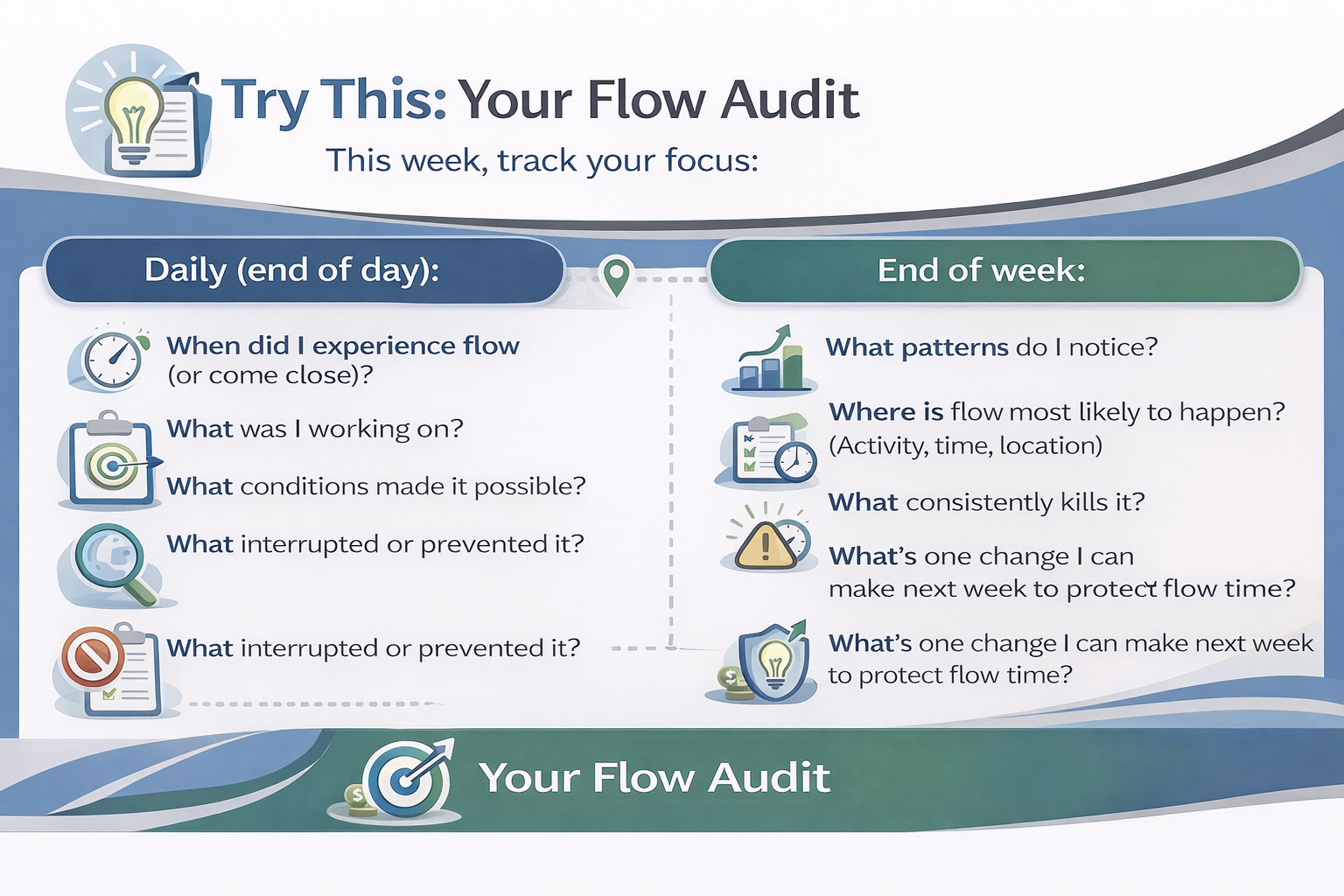
Try This: Your Flow Audit
This week, track your focus:
Daily (end of day):
- When did I experience flow (or come close)?
- What was I working on?
- What conditions made it possible?
- What interrupted or prevented it?
End of week:
- What patterns do I notice?
- Where is flow most likely to happen? (Activity, time, location)
- What consistently kills it?
- What’s one change I can make next week to protect flow time?
References:
- Csikszentmihalyi, M. (2008). Flow: The Psychology of Optimal Experience. Harper Perennial Modern Classics.
- Newport, C. (2016). Deep Work: Rules for Focused Success in a Distracted World. Grand Central Publishing.
- Newport, C. (2019). Digital Minimalism: Choosing a Focused Life in a Noisy World. Portfolio.
If you’re struggling to find focus, meaning, or satisfaction in work that feels constantly fragmented, I’d be honored to help. Schedule a free discovery session and let’s talk about what protecting your capacity for deep work could look like.