Your cart is currently empty!
The Energy Audit: When Exhaustion Goes Deeper Than Sleep
•
My dog was waiting by the back door, ready to go outside. I stood up from the couch, made it to the top of the stairs, and had to sit down.
Not because I was physically injured. Not because I was out of shape.
Because I had no energy left.
It wasn’t a lack of motivation. It wasn’t laziness. I literally couldn’t make it down the back stairs without stopping to rest.
That’s when I knew something was deeply wrong.
When Depletion Becomes Undeniable
I’d been turning down invitations to things I normally loved. I was barely getting through the bare minimum—work, basic self-care, feeding the dog. My tolerance for challenges and frustration had disappeared, which was very unusual for me.
I could sleep for hours and still wake up feeling empty. I’d push through a productive day and then crash so hard I couldn’t function. I was running on stress—adrenaline, urgency, pressure—and then collapsing when the pressure lifted.
I didn’t realize I was stuck in a chronic stress-overwhelm cycle. I just thought I needed to try harder, rest better, manage my time more efficiently.
But the exhaustion wasn’t about effort or sleep.
It was about energy at a much deeper level.
The Biology of Depletion
Dr. Aimie Apigian’s work in The Biology of Trauma explores how chronic stress doesn’t just exhaust us mentally—it depletes us cellularly. When your nervous system is stuck in survival mode, your body’s energy production systems get dysregulated.
Your mitochondria—the parts of your cells that generate energy—can’t function optimally when you’re chronically activated. Sleep helps, but it doesn’t fully restore you if your nervous system never shifts out of threat response.
Deb Dana’s polyvagal work reinforces this: we can’t access rest and restoration when our autonomic nervous system is stuck in fight-flight-freeze.
So the exhaustion you feel isn’t just “tiredness.” It’s a biological state where your body can’t generate or sustain energy the way it’s designed to.
And willpower won’t fix that.
The 7 Types of Rest (And Why Sleep Isn’t Enough)
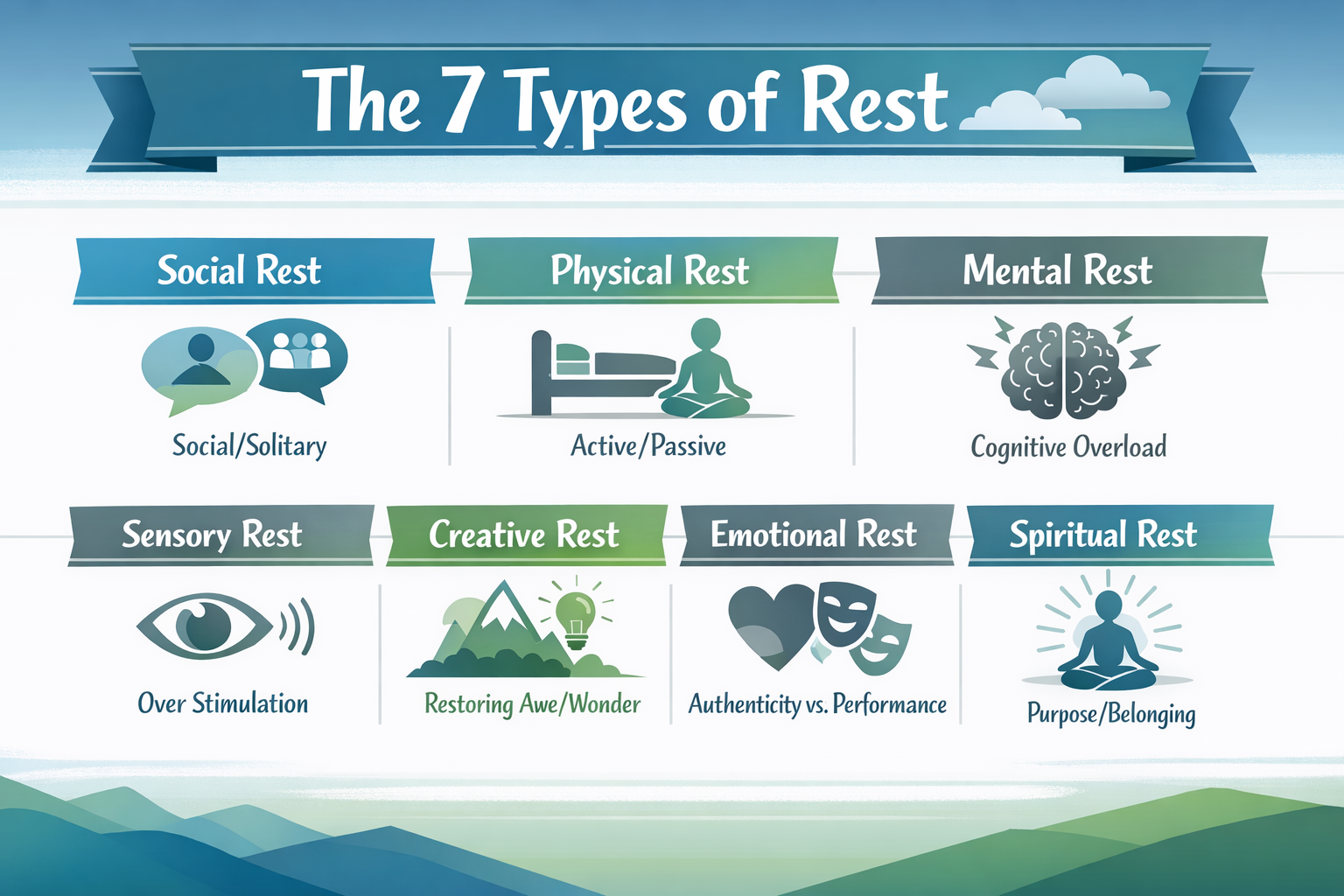
Physician Saundra Dalton-Smith identified seven types of rest that humans need to function well. Most of us only focus on physical rest—sleep, downtime, not moving. But when we’re chronically depleted, the other six types matter just as much.
Here are three that are especially critical for people navigating workplace stress and burnout:
1. Mental Rest: Cognitive Overload and Decision Fatigue
What it is: Your brain needs breaks from constant thinking, problem-solving, and decision-making.
What depletion looks like:
- You can’t concentrate even on simple tasks
- You reread the same email three times and still don’t absorb it
- Small decisions (what to eat, what to wear) feel overwhelming
- You’re mentally “foggy” even after sleeping
What mental rest requires:
- Breaks between cognitively demanding tasks
- Not working through lunch or after hours
- Reducing unnecessary decisions (routines, systems, saying no)
- Stopping before your brain is completely fried
2. Emotional Rest: Authenticity vs. Performance
What it is: Your nervous system needs space where you’re not managing how others perceive you.
What depletion looks like:
- You’re exhausted after meetings, even “good” ones
- You feel like you’re performing at work, not just working
- You can’t be honest about how you’re doing
- You’re managing everyone else’s emotions while suppressing your own
What emotional rest requires:
- Relationships where you don’t have to perform
- Permission to say “I’m struggling” without consequences
- Time alone or with people who don’t require emotional labor
- Reducing people-pleasing and boundary violations
3. Social Rest: Energy Vampires and Introvert Recovery
What it is: Recognizing that not all social interaction restores you—some depletes you.
What depletion looks like:
- Even enjoyable social events leave you drained
- You need significant alone time to recover from interactions
- Certain people or environments exhaust you more than others
- You’re avoiding social situations because you don’t have the energy
What social rest requires:
- Honoring your need for solitude (especially if you’re introverted)
- Limiting time with people who drain rather than restore
- Saying no to social obligations that feel depleting
- Recognizing that “rest” might mean being alone, not being entertained
The Turning Point: Addressing Energy at the Cellular Level
For me, the shift came when I took Dr. Apigian’s Biology of Trauma course. It gave me a framework for understanding that my exhaustion wasn’t just psychological—it was biological.
I didn’t have the resources for extensive testing or professional support at the time. But the course gave me a starting point: supporting my body’s ability to generate energy at the cellular level.
I started with a few targeted supplements, most importantly specific forms of magnesium. I’d tried magnesium before, but not the varieties that were actually effective for cellular energy and nervous system regulation.
I also incorporated nervous system regulation practices—breathwork, grounding exercises, intentional rest—to help my body shift out of chronic stress response.
It’s been a long road, and I’m still on it. But those changes gave me a foundation I didn’t have before.
One other insight that surprised me: I needed creative rest—but without tying it to productivity.
As a high performer, even my hobbies had become goal-oriented. I needed to allow myself time for creativity, for beauty, for wonder—without it needing to produce anything. That kind of rest doesn’t feel productive in the moment, but it restores something deeper.
The Tool: Weekly Energy Mapping
If you’re chronically depleted, you might not know what’s draining you. Everything feels hard. Everything feels exhausting.
An energy audit helps you identify patterns so you can make informed choices about how you spend your limited capacity.
How to Do It:
For one week, track your energy levels three times a day (morning, midday, evening). Rate yourself 1-10, and note:
Physical:
- How does my body feel? (Energized, heavy, tense, exhausted)
- Did I sleep well? Eat well? Move?
Emotional:
- Am I calm, anxious, frustrated, numb?
- Did I have to perform or suppress emotions today?
Social/Relational:
- Who did I interact with?
- Which interactions felt draining vs. restoring?
Work Tasks:
- What did I spend time on?
- Which tasks energized me? Which depleted me?
- Was I working reactively (urgency-driven) or proactively?
What to Look For:
- Patterns over time: Are certain days/times consistently worse?
- Specific drains: Do certain meetings, people, or tasks always leave you depleted?
- False rest: Are you doing things you think are restful (scrolling, TV) but not actually recovering?
- Energy vampires: Are there relationships or obligations that consistently drain more than they give?
Once you see the patterns, you can start making changes:
- Protect energy-giving activities
- Set boundaries around energy-draining ones
- Build in real rest (not just distraction)
- Address biological factors (sleep quality, nutrition, nervous system regulation)
For Leaders: The Urgency Currency Problem
If you’re managing a team, here’s what you need to know:
When urgency becomes currency—when everything is urgent, every request is top priority, every project is critical—people stop being able to discern real urgency from manufactured pressure.
They run on adrenaline. They crash hard when the pressure lifts. They burn out.
A “customer service above and beyond” culture sounds excellent in theory. But when it leads teams to accept more projects than they can handle, it doesn’t create excellence—it creates overwhelm.
Questions to Ask Yourself:
- Is my team always operating under pressure? If yes, that’s not sustainable—it’s a nervous system stressor that depletes energy over time.
- Do we say yes to more than we can handle? If so, you’re not serving clients well—you’re burning out your team.
- Do people have recovery time built into their schedules? Back-to-back meetings, constant availability, and no transition time between tasks prevent energy restoration.
- Am I modeling rest, or am I modeling overwork? If you’re responding to emails at midnight and working through weekends, your team will feel pressure to do the same.
Energy management isn’t about individual resilience. It’s about creating organizational conditions where people can sustain their work without depleting themselves.
Closing Thoughts
If you’re exhausted in a way that sleep doesn’t fix, you’re not weak. You’re not failing at self-care.
You might be dealing with nervous system dysregulation, cellular energy depletion, or chronic stress that’s gone on too long without real recovery.
The fix isn’t just “rest more.” It’s:
- Understanding the different types of rest you need
- Addressing energy at the biological level (nutrition, supplements, nervous system regulation)
- Identifying what actually drains you (not just what you think should be tiring)
- Setting boundaries that protect your capacity
You don’t have to figure it all out at once. Start with one week of energy tracking. Notice the patterns. Make one small change.
That’s how you begin to climb out of depletion—not by pushing harder, but by understanding what your body and nervous system actually need.
Try This: One-Week Energy Tracker
Materials: A notebook or notes app
Daily (3x/day – morning, midday, evening):
- Rate your energy: 1-10
- Note physical state: Rested? Tense? Depleted?
- Note emotional state: Calm? Anxious? Numb?
- Note what you did since last check-in:
- Meetings/interactions (with whom?)
- Tasks (what kind?)
- Rest activities (did they actually restore you?)
End of week:
- What patterns do you notice?
- What consistently drains you?
- What actually restores you?
- What one change could you make based on this data?
References:
- Apigian, A. (2022). The Biology of Trauma: Understanding the Physiology of Trauma and Its Treatment. Sounds True.
- Dana, D. (2018). The Polyvagal Theory in Therapy: Engaging the Rhythm of Regulation. W.W. Norton & Company.
- Dalton-Smith, S. (2021). Sacred Rest: Recover Your Life, Renew Your Energy, Restore Your Sanity. FaithWords.
- Whitten, A. (2023). Eat for Energy: How to Beat Fatigue, Supercharge Your Mitochondria, and Unlock All-Day Energy. Hay House Inc.
If you’re navigating chronic depletion and need support finding a sustainable path forward, I’d be honored to help. Schedule a free discovery session and let’s talk about what real energy restoration could look like for you.
Not ready for a conversation but want to learn more? Visit www.CandidCC.com.