
You’re capable.
That means you can do most things yourself when you need to.
But here’s the question: When do you actually need to?
Just because you can doesn’t mean you have to. Just because you’re good at something doesn’t mean it should consume your time.
The 80/20 principle—also known as the Pareto Principle—suggests that roughly 80% of results come from 20% of efforts. In other words, most of what we do doesn’t move the needle. A small portion of our activities creates most of our results and satisfaction.
But knowing this intellectually and acting on it? Those are two different things.
Because letting go—even of things that don’t matter—is harder than it sounds.
The Question Most Capable People Avoid
If you’re skilled, conscientious, and used to getting things done, you’ve probably built an identity around being the person who can handle it.
The problem solver. The go-to person. The one who makes it happen.
And that’s valuable. It’s a strength.
But it’s also a trap.
Because when you’re capable of doing something yourself, giving yourself permission to not do it feels irresponsible. Or wasteful. Or like you’re somehow failing.
So instead of asking, “Is this the best use of my time?” you default to, “Can I do this?”
And the answer is almost always yes.
But the better question is: Should you?
What’s in Your 80%?
The 80% is the stuff that takes up time, attention, and energy—but doesn’t create proportional value.
It might be:
- Tasks you’re good at but don’t enjoy
- Responsibilities you’ve inherited that no longer serve you
- Commitments that made sense once but don’t anymore
- “Good” work that keeps you too busy for great work
Richard Koch, in Simplify, argues that most people spend the majority of their time on activities that deliver minimal results or satisfaction. Not because they’re lazy—but because they haven’t stopped to question what’s actually worth doing.
The hard part isn’t identifying the 80%. It’s letting it go.
Why Capable People Struggle to Let Go
If you can do something well, releasing it can feel like:
1. Losing control
“If I don’t do it, it won’t get done right.”
Maybe. But is “done right by your standards” more important than having time for what actually matters to you?
2. Wasting your skills
“I’m good at this. Shouldn’t I be using that?”
Being good at something doesn’t obligate you to keep doing it—especially if it drains you or keeps you from higher-priority work.
3. Letting people down
“They’re counting on me.”
That might be true. But if saying yes to them means saying no to yourself repeatedly, the cost is real.
4. Admitting limits
“I should be able to handle this.”
You might be able to. But capacity isn’t infinite. Choosing where to spend your energy is strategic, not weak.
The Permission Question
Here’s the shift:
Instead of asking, “Can I do this myself?” try asking:
“What’s more important to me—the time I’d spend doing this, or the satisfaction of doing it myself?”
And then:
“If I didn’t do this, what would I be doing instead? Is that more valuable?”
Sometimes the answer is yes—you genuinely want to do it. It brings you joy, aligns with your skills, or matters in a way that can’t be outsourced.
But often, the answer is: “I’m doing this out of habit, obligation, or the belief that I ‘should’—not because it’s actually worth my time.”
That’s when simplification becomes possible.
Limited Resources, Intentional Choices
We all have limited resources:
- Time
- Money
- Energy
- Attention
- Skills
The question isn’t whether you can do something. It’s whether doing it is the best use of those resources.
And more importantly: Does how you spend those resources match what you say matters to you?
If you say relationships matter, but you’re too busy for the people you care about—your actions don’t align with your values.
If you say creativity fuels you, but you never make time for it because you’re handling “more important” tasks—you’re prioritizing urgency over meaning.
If you say rest is essential, but you fill every margin with productivity—you’re not honoring what you claim to value.
This isn’t about judgment. It’s about clarity.
Where is your energy actually going? And is that where you want it to go?
The 80/20 Audit
Koch suggests a simple but powerful exercise: identify the 20% of activities that create 80% of your results and satisfaction.
Then ask: What happens to everything else?
Step 1: List Your Activities
Write down how you spent your time over the past month. Include:
- Work tasks
- Personal responsibilities
- Social commitments
- Hobbies and downtime
Step 2: Rate Each Activity
For each one, ask:
- Results: Does this create meaningful outcomes?
- Satisfaction: Does this bring me energy or drain me?
- Alignment: Does this reflect what I say matters most?
Step 3: Identify the 20%
Which activities consistently score high on results, satisfaction, and alignment?
Those are your 20%. Protect them. Prioritize them. Build your life around them.
Step 4: Question the 80%
For everything else, ask:
- Can I eliminate it? (Stop doing it entirely)
- Can I delegate it? (Let someone else handle it)
- Can I simplify it? (Reduce time/energy spent)
- Can I automate it? (Create systems that reduce manual effort)
Not everything in the 80% can go. Some of it is necessary.
But more of it than you think is optional.
What You Might Let Go Of
Here are some examples of what people often discover in their 80%:
At work:
- Meetings you don’t need to attend
- Tasks you’re doing because “you’ve always done them”
- Responsibilities that could be shared or delegated
- Perfectionism on low-stakes deliverables
At home:
- Commitments that no longer serve you
- Projects you started but no longer care about
- Social obligations rooted in guilt, not connection
- Standards that are yours alone (and exhausting to maintain)
In life:
- Goals you inherited from past versions of yourself
- Hobbies you’re “supposed” to enjoy but don’t
- Habits that made sense once but don’t anymore
The goal isn’t to become ruthlessly efficient or eliminate joy.
The goal is to stop spending time on things that don’t create results or satisfaction—so you have more capacity for what does.
The Relief That Follows
When people finally let go of something in their 80%, the most common response isn’t regret.
It’s relief.
“I didn’t realize how much that was weighing on me.”
Simplification doesn’t feel like loss when what you’re releasing was draining you.
It feels like reclaiming space. Energy. Time.
And in that space, the 20%—the work that matters, the relationships that restore you, the creativity that fuels you—gets room to grow.
For Leaders: What Are You Asking Your Team to Carry?
If you manage people, it’s worth asking: What’s in their 80%?
Are there tasks, meetings, or responsibilities your team is carrying that don’t create meaningful results?
Things they do because “we’ve always done it this way” or because no one has stopped to question whether it’s still necessary?
Simplification isn’t just personal—it’s organizational.
Questions to ask:
- What meetings could we eliminate or shorten?
- What reports are we creating that no one reads?
- What processes exist because of past constraints that no longer apply?
- What responsibilities could be redistributed or removed?
When you free your team from low-value work, you’re not just being nice.
You’re creating capacity for the work that actually matters.
Closing Thoughts
You’re capable. That’s not in question.
But capability isn’t the same as obligation.
Just because you can do something doesn’t mean it’s the best use of your time, energy, or skills.
Simplifying isn’t about doing less for the sake of doing less.
It’s about doing less of what doesn’t matter—so you can do more of what does.
Your resources are limited. Your capacity is real.
How you spend them is a choice.
Make sure it’s a choice that aligns with what you actually value—not just what you’ve always done.
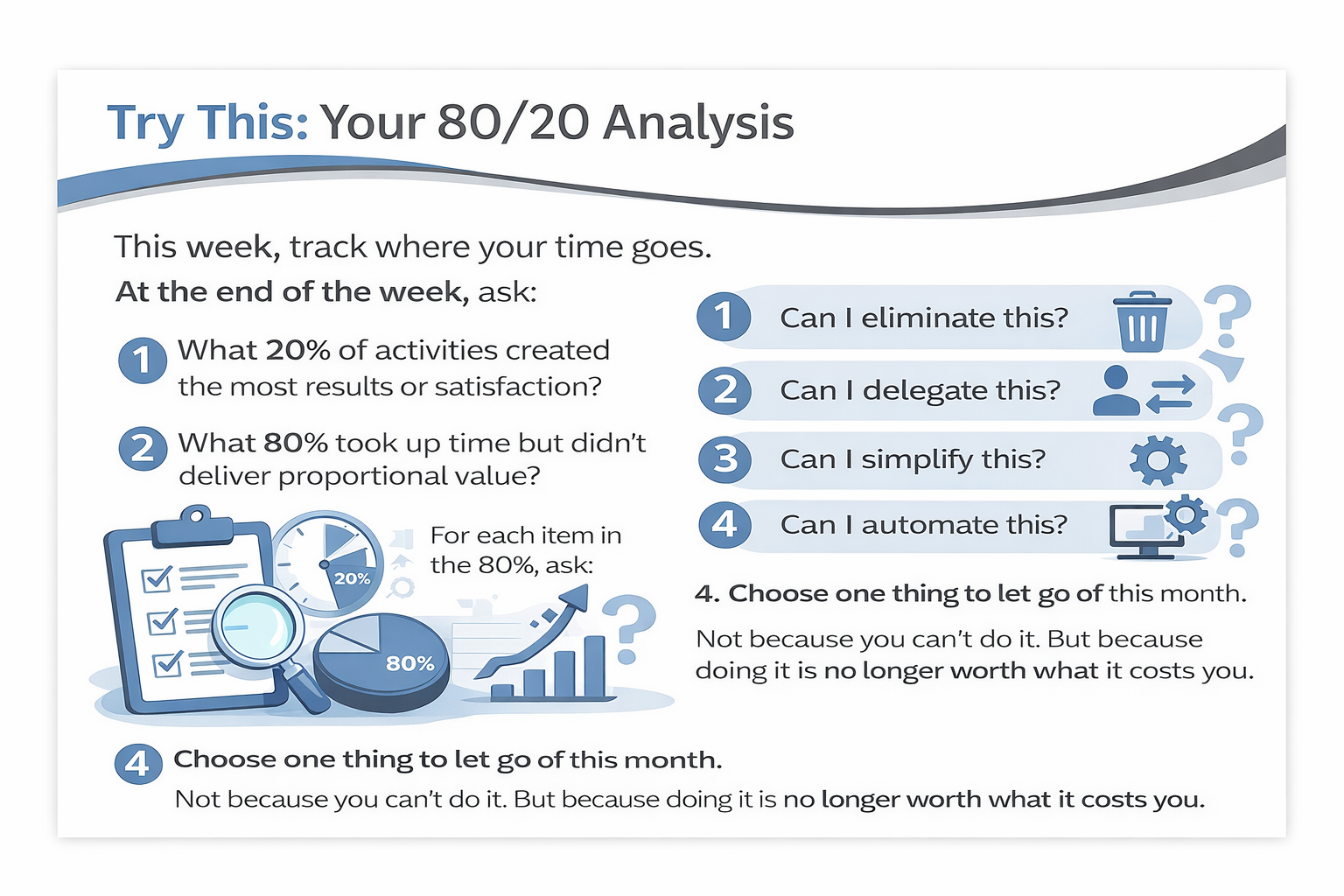
Try This: Your 80/20 Analysis
This week, track where your time goes.
At the end of the week, ask:
1. What 20% of activities created the most results or satisfaction?
2. What 80% took up time but didn’t deliver proportional value?
3. For each item in the 80%, ask:
- Can I eliminate this?
- Can I delegate this?
- Can I simplify this?
- Can I automate this?
4. Choose one thing to let go of this month.
Not because you can’t do it. But because doing it is no longer worth what it costs you.
References:
- Koch, R. (2016). Simplify: How the Best Businesses in the World Succeed. Piatkus.
- Koch, R. (1998). The 80/20 Principle: The Secret to Achieving More with Less. Crown Business.
- Newport, C. (2021). A World Without Email: Reimagining Work in an Age of Communication Overload. Portfolio.
If you’re navigating overwhelm and need support identifying what’s worth keeping and what’s safe to release, I’d be honored to help. Schedule a free discovery session and let’s talk about what simplification without sacrifice could look like for you.