
Introversion isn’t a deficit.
But in workplaces that reward being the loudest voice in the room, it can feel that way.
If you’re someone who thinks before speaking, who finds large groups draining, who’d rather have one meaningful conversation than work a room full of small talk—you’ve probably been told, at some point, to “put yourself out there more.”
As if being quieter means you have less to offer.
As if presence requires performance.
But here’s the truth: quiet people often carry more weight when they finally speak—because people know they don’t talk just to hear themselves.
And that’s a form of leadership many workplaces desperately need.
Strengths Shift Over Time
Our character strengths aren’t fixed. They evolve as we do.
The VIA Character Strengths assessment identifies 24 core strengths—traits like honesty, kindness, perseverance, fairness, love of learning, curiosity, and more. Research shows that understanding and leveraging your top strengths leads to greater wellbeing, engagement, and resilience.
But your top strengths ten years ago might not be your top strengths today.
Example:
Ten years ago, someone’s top three might have been perseverance, honesty, and kindness. Sticking to something really mattered. Having the grit to accomplish what you set out to do was central to identity.
Today, those same strengths might shift to honesty, love of learning, and fairness.
What changed?
Life. Experience. Perspective.
Goals, values, and circumstances shift. If what you set out to do no longer holds the same value, why continue just out of determination? That kind of rigid perseverance doesn’t always serve growth—it can keep you stuck in commitments that no longer align with who you are.
Fairness might rise to the top after experiencing or witnessing injustice. Love of learning might grow as you realize that expertise isn’t static—it requires continuous evolution.
Our experiences shape us. Our priorities change. We work on ourselves—intentionally or not.
And that’s not weakness. It’s growth.
Honesty as a Quiet Strength
For many introverts, honesty becomes a core strength—not just in being truthful, but in being willing to speak uncomfortable truths when it matters.
This can serve well in quieter, one-on-one settings. But it’s harder to pull out in extroverted, high-energy group environments.
The question becomes: What matters enough to me to take a stand?
For introverts, if something is worth saying in a meeting or public gathering, it probably matters deeply. And the people around them often know that.
They don’t speak without purpose. They don’t fill space for the sake of filling it.
So when they do speak, it carries weight.
If trust has been built—if the group knows this person doesn’t just like hearing their own voice—what they say is often taken more seriously than louder, more frequent voices.
The Struggle with Performance
Early in many introverts’ careers, being in front of groups is required. It’s part of the job.
And it can feel awful.
There’s often an instinct to emulate people who seem to do it well—charismatic, effortless, energized by the spotlight. But trying to replicate someone else’s style when it doesn’t fit who you are? That’s exhausting.
It drains energy instead of creating it.
The shift happens when you find your own stride.
When you stop trying to perform extroversion and start asking: What kind of engagement actually fits me?
For many introverts, the difference-maker is purpose.
Knowing why you’re standing in front of people. Having a clear goal. Feeling prepared.
If the task is:
- Buying time for preparations to finish
- Shifting the mood or dynamic of a room
- Assisting with a transition
- Sharing critical information
That’s manageable. Even energizing, when done well.
But seeking attention for its own sake? Being front and center just to be visible? That doesn’t align.
And that’s okay.
The Cost of Invisibility (And the Benefit)
Introverts often don’t seek out the spotlight. Which means they don’t always get noticed.
In performance-driven, visibility-rewarding cultures, that can be a liability. Promotions, opportunities, recognition—they often go to the people who are most visible, not necessarily the most effective.
But here’s the flip side:
When introverts are noticed, it’s usually with appreciation and respect.
Not because they networked aggressively or self-promoted constantly.
But because their contributions were substantive. Their presence was intentional. Their words mattered.
And for many introverts, that’s a trade they’ll take.
Quality of recognition over quantity. Depth of impact over breadth of visibility.
What Quiet Leadership Looks Like
Susan Cain’s Quiet transformed how introverts are understood in professional settings. She dismantled the myth that leadership requires charisma, loudness, or constant visibility.
Quiet leaders often:
Listen more than they speak
They gather information, understand context, and think before responding. This creates better decisions and deeper trust.
Speak with purpose
When they contribute, it’s because they have something meaningful to add—not because silence feels uncomfortable.
Build trust through consistency
They don’t need to be the most visible person in the room. They build credibility through follow-through, integrity, and depth of thought.
Create space for others
Introverts often excel at drawing out quieter voices. They notice who hasn’t spoken. They ask thoughtful questions. They don’t dominate conversations.
Think strategically
Reflection and processing time lead to stronger insights. Introverts often see patterns and connections others miss because they take time to think deeply.
These aren’t “soft skills.” They’re leadership skills that many loud, fast-moving workplaces desperately need.
Nervousness Isn’t Weakness
Even introverts who’ve found their stride still get nervous before speaking in public or taking on visible roles.
But nervousness can be reframed.
It’s not a sign that you’re not ready or not capable.
It’s a sign that it matters to you. That you care.
If it didn’t matter, you wouldn’t feel the weight of it.
Nervousness keeps you sharp. It reminds you to prepare. It signals respect for the moment and the people you’re engaging with.
The goal isn’t to eliminate it. It’s to recognize it as part of showing up for something meaningful.
For Leaders: Stop Rewarding Only the Loud
If you manage people, it’s worth asking: Are you only noticing the loudest voices?
Because if visibility equals value in your culture, you’re missing a lot.
Questions to reflect on:
- Who speaks less but listens more deeply?
- Who contributes thoughtfully but not frequently?
- Who builds trust quietly without needing recognition?
- Are promotions and opportunities going to the most visible people—or the most effective?
How to create space for quieter strengths:
- Don’t default to verbal participation as the only measure of engagement
- Give people time to think before expecting responses (not everyone processes out loud)
- Recognize contributions in ways that don’t require public performance (written reflections, one-on-one input, asynchronous feedback)
- Ask directly: “I haven’t heard from you yet—what’s your take on this?”
Introverts aren’t waiting to be “fixed.” They’re waiting for environments that value depth over volume.
Your Strengths Are Allowed to Change
If your top strengths have shifted over the years, that’s not inconsistency.
It’s evolution.
Maybe perseverance mattered deeply once—but now, learning and fairness take priority.
Maybe kindness was central—but now, honesty and courage feel more essential.
You’re allowed to grow. To change. To let go of what no longer serves you and lean into what does.
Take the VIA Character Strengths assessment if you haven’t recently. See what’s shifted. Notice what’s emerged.
And then ask: Am I building my life and work around my actual strengths—or the ones I think I “should” have?
Closing Thoughts
You don’t need to be the loudest to lead.
You don’t need to perform extroversion to have impact.
You don’t need the spotlight to matter.
Quiet leadership is real. It’s strategic. It’s powerful.
And the people who truly see it? They’ll take you seriously—because they know you don’t speak just to fill space.
You speak because it matters.
And that’s worth more than all the noise in the world.
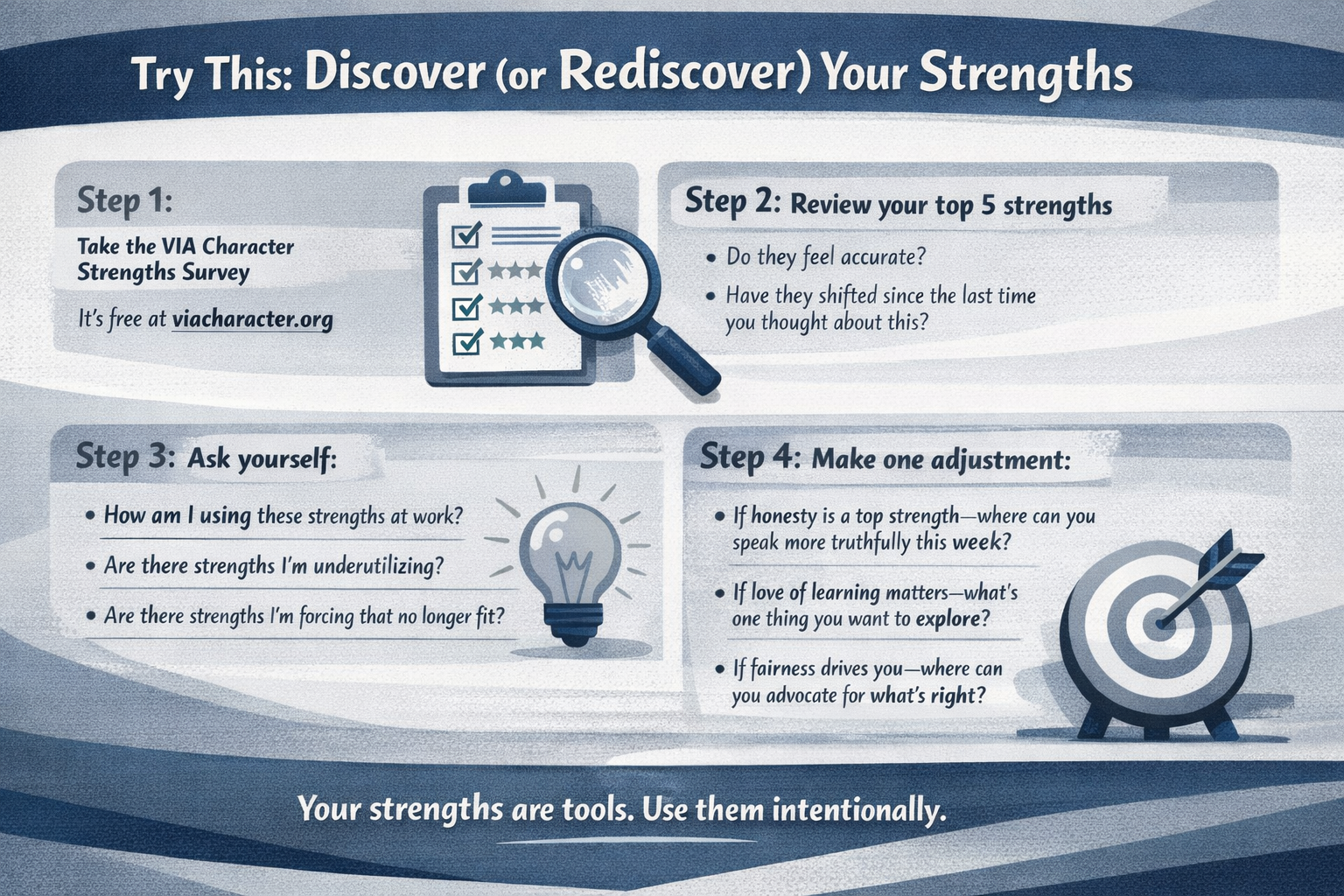
Try This: Discover (or Rediscover) Your Strengths
Step 1: Take the VIA Character Strengths Survey
It’s free at viacharacter.org
Step 2: Review your top 5 strengths
Do they feel accurate? Have they shifted since the last time you thought about this?
Step 3: Ask yourself:
- How am I using these strengths at work?
- Are there strengths I’m underutilizing?
- Are there strengths I’m forcing that no longer fit?
Step 4: Make one adjustment
If honesty is a top strength—where can you speak more truthfully this week?
If love of learning matters—what’s one thing you want to explore?
If fairness drives you—where can you advocate for what’s right?
Your strengths are tools. Use them intentionally.
References:
- Cain, S. (2013). Quiet: The Power of Introverts in a World That Can’t Stop Talking. Broadway Books.
- Peterson, C., & Seligman, M. E. P. (2004). Character Strengths and Virtues: A Handbook and Classification. Oxford University Press.
- Howell, R. (2016). Shine: Using Brain Science to Get the Best from Your People. Penguin.
If you’re navigating a workplace that doesn’t always value quiet strength, I’d be honored to help. Schedule a free discovery session and let’s talk about how to lead authentically without performing extroversion.