Your cart is currently empty!
Boundaries as Stability: Creating the Conditions for Growth
•
Boundaries often get framed as a way to limit what comes in — other people’s demands, schedule creep, emotional overload. But boundaries also shape what can grow out of your life: capacity, creativity, learning, steadiness, and professional momentum. At their core, boundaries are a tool for regulating your internal environment so that you can think clearly, connect intentionally, and act with purpose.
This isn’t just a feel-good idea. A large body of research in neuroscience, trauma and stress studies, positive psychology, and experiential education points toward a shared principle:
We grow best when our nervous system feels stable enough to explore, experiment, and stretch.
Boundaries help create that stability.
The Physiology of “Enough”
When stress is chronically high or unpredictable, the brain narrows its focus toward safety, efficiency, and threat detection. That state is adaptive — it keeps us alive — but it’s not especially supportive of:
- long-term planning
- creative problem-solving
- flexible thinking
- receiving feedback
- learning new skills
- collaborative communication
Neuroscience research shows that when we experience ongoing overload, the prefrontal cortex (responsible for decision-making, working memory, and reasoned judgment) becomes less accessible. Boundaries — whether they protect time, emotional bandwidth, or workload — help interrupt this cycle. They reduce unnecessary stress signals, allow for recovery, and reopen access to the cognitive functions required for learning and growth.
This doesn’t require dramatic lifestyle changes. Even small, consistent boundaries can shift your internal state from survival mode toward a foundation of “enoughness” — enough energy, enough clarity, enough margin to engage with your work on purpose.
Why Boundaries and Learning Go Hand-in-Hand
Experiential education offers a simple but powerful model: the comfort zone, the learning zone, and the panic zone. The learning zone is the middle space where challenge is present but not overwhelming — where the brain is activated, curious, and primed for growth.
Boundaries help define and maintain this zone. They:
- protect the time needed for reflection and skill-building
- reduce distractions so learning can deepen
- prevent the slide from stretching into over-extension
- create predictable rhythms that help the nervous system stay regulated
Positive psychology research reinforces this. Skills like curiosity, resilience, optimism, and cognitive flexibility flourish when people feel safe, supported, and resourced. These strengths don’t emerge as reliably when someone is depleted or stretched past capacity.
In that sense: Boundaries aren’t a barrier to growth; they are the infrastructure that makes growth sustainable.
A Trauma-Informed Lens on Boundaries and Capacity
Trauma-informed frameworks highlight that people experience stress, uncertainty, and “stretch” differently. Internal thresholds vary based on past experiences, current pressures, systemic factors, and individual nervous-system sensitivity.
This perspective reminds us that:
- Growth isn’t linear or uniform.
- People need different levels of recovery, clarity, and predictability.
- What feels like a stretch to one person may feel unsafe to another.
- A regulated system learns; a dysregulated one protects.
Applying trauma-informed principles means approaching boundaries (your own and others’) with curiosity rather than judgment. Instead of asking “Why is this hard?” we can ask “What would make this feel more doable right now?”
This shift creates more compassionate environments — at work, at home, and internally — where authentic growth becomes accessible.
A Practical Experiment: The 7-Day Boundary Reset
Here’s a simple way to explore how boundaries affect your energy, clarity, and capacity:
Choose one boundary to practice for one week.
Examples:
- A 90-minute focus block on two days
- No email or messaging after a specific time
- A protected lunch break
- A weekly “reset hour” with no meetings or tasks for others
- A commitment to say “I need to check my capacity” before responding to requests
Then, each day, reflect for 3–5 minutes:
- What felt easier because of this boundary?
- What felt harder?
- What did this boundary make possible today?
- What did I learn about my capacity or tendencies?
At the end of the week, do a simple debrief:
Keep — Refine — Release
- What’s worth continuing?
- What needs adjustment?
- What didn’t actually serve you?
This short cycle mirrors experiential learning: plan → act → reflect → adjust. It helps you understand what boundaries genuinely support your work and well-being — not in theory, but in practice.
Taking the Long View
Boundaries are not the end goal; they are a foundation. When you use them to regulate your internal environment, you create conditions for steadier thinking, deeper learning, better decision-making, and more sustainable professional growth.
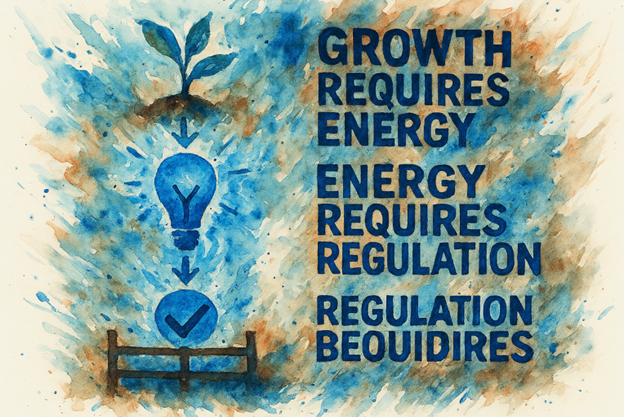
Growth requires energy.
Energy requires regulation.
Regulation requires boundaries.
Even one small, well-chosen limit can shift your internal state enough to change what feels possible — in your work, your relationships, and your ability to stretch into new challenges with confidence.